Uniform shirts are a popular choice for businesses looking to create a professional and consistent appearance across their workforce. However, each working environment – from offices and banking to restaurants and retail – has different requirements for fabric, fit, design, and all-day comfort.
This guide from Tan Pham Gia Uniform explains how to select the right uniform shirt solution based on working environment, industry, fabric, design, and budget, giving businesses a practical foundation before moving forward with bulk production.
Why Should Businesses Choose Uniform Shirts for Corporate Workwear?
Uniform shirts are widely used as corporate uniforms because they combine a professional appearance, brand consistency, and versatility across different working environments. The following are some of the key factors businesses typically consider.
Uniform Shirts Help Build a Professional Corporate Image
Uniform shirts create a professional appearance through their clean silhouettes and consistent design across the workforce.
- Create a consistent appearance among employees when working and interacting with customers.
- Suit a wide range of industries, from corporate offices to service businesses.
- Maintain a polished appearance throughout the working day, including during meetings with customers and business partners.
Uniform Shirts Are Suitable for Offices and Customer-Facing Roles
Uniform shirts work well across a variety of office and customer-facing situations, from daily internal work to meetings with clients and partners.
- Daily office work.
- Welcoming customers and business visitors.
- Sales teams meeting customers off-site.
- Working with business partners.
- Attending important meetings and corporate events.
Uniform Shirts Strengthen Brand Recognition
Uniform shirts can reinforce brand recognition through consistent design elements across the entire uniform program.
- Brand colors aligned with corporate identity guidelines.
- Clearly positioned logos in approved locations.
- Consistent styling across departments.
- Additional brand details such as collar colors, piping, and placket design.
Uniform Shirts Can Be Designed for Both Men and Women
Uniform shirts can be developed for both male and female employees while maintaining a consistent brand identity.
- Consistent colors, patterns, and logo placement.
- Separate men’s and women’s fits for better comfort and proportions.
- A unified brand appearance despite differences in garment construction and fit.
Businesses Can Customize Fit, Style, and Fabric
Businesses can customize multiple elements of uniform shirts based on working conditions and brand requirements.
- Fit: Slim, regular, or relaxed silhouettes.
- Collar: Traditional office or business-casual styles.
- Sleeves: Long-sleeve or short-sleeve options.
- Fabric: Selected according to the working environment.
- Color and branding: Developed in line with corporate identity guidelines.

Which Fabrics Are Suitable for Uniform Shirts?
Businesses can choose from different fabric groups for uniform shirts, with each offering different performance characteristics such as shape retention, breathability, wrinkle resistance, or a more natural hand feel.
Polyspun – For Customer- and Business-Facing Environments
Polyspun is suitable for uniform shirts used in environments where employees frequently interact with customers and business partners. Its structure can provide good shape retention while helping reduce wrinkling throughout the working day.
- Structured surface that helps the shirt maintain its shape during extended wear.
- Wrinkle-resistant characteristics that make the garment easier to maintain.
- Suitable for office staff, sales teams, receptionists, and customer-facing roles.
Before bulk production, businesses should confirm the fabric composition and GSM with the manufacturer to ensure the selected specification matches the actual requirements of each department.

Dry Cool – For Active and Outdoor Working Environments
Dry Cool is suitable for uniform shirts used in active or outdoor environments, where breathability and quick-drying performance are important.
- Breathable and quick-drying characteristics to support comfort during continuous movement.
- Suitable for field sales teams, event staff, logistics personnel, and technical teams.
Because these roles involve frequent movement, businesses should select a fabric construction that maintains the appearance and structure of a uniform shirt rather than making the garment feel overly similar to sportswear.
100% Cotton – For Breathability and Natural Comfort
100% Cotton is suitable for working environments where moisture absorption and natural comfort are priorities.
- Natural, soft hand feel with good moisture absorption.
- Comfortable for employees wearing the shirt throughout the working day.
- Suitable for offices, service environments, and primarily indoor workplaces.
Because natural cotton can wrinkle more easily than blended fabrics, businesses should consider wrinkle behavior, garment construction, and care requirements when selecting the fabric.

Bamboo – For Businesses Prioritizing Natural Comfort
Bamboo fabric is suitable for businesses that prioritize a soft, natural wearing experience throughout the working day.
- Soft hand feel, breathability, and good moisture absorption.
- Suitable for corporate and service environments.
- A potential option when employee comfort is a key consideration.

Kate – A Practical Choice for Corporate Uniforms
Kate is a practical option for corporate uniforms, particularly for businesses looking for a fabric that is easy to maintain and suitable for regular daily use.
- Relatively smooth surface that is easy to care for.
- Stable shape retention for long-term use.
- Suitable for office, administrative, and service uniforms.
Modal – For a Softer, More Premium Wearing Experience
Modal is suitable for businesses that prioritize softness and a more premium wearing experience.
- Soft hand feel, natural drape, and a smooth feel against the skin.
- Suitable for corporate environments and premium brand positioning.
Businesses may consider Modal when they want to enhance the wearing experience for management teams or employees who regularly represent the company’s image.

Which Uniform Shirt Fabric Should You Choose for Each Working Environment?
Fabric selection should be based on the actual working environment rather than applying one fabric specification across the entire organization.
| Working Environment | Key Priorities | Suggested Fabrics | Suitable For |
|---|---|---|---|
| Office, Banking & Finance | Polished appearance, shape retention, wrinkle resistance, all-day comfort | Polyspun, Kate, Modal | Office staff, bank tellers, management |
| Services & Retail | Comfort, easy care, professional appearance | Polyspun, Kate, Bamboo | Service staff, store teams, showroom staff |
| Restaurants & F&B | Breathability, mobility, easy care, frequent use | Polyspun, Kate, Dry Cool | Restaurant staff, service staff, managers |
| Sales & Customer-Facing Roles | Shape retention, wrinkle resistance, professional appearance | Polyspun, Modal, Kate | Sales teams, consultants, customer-facing staff |
| Events & Mobile Teams | Lightweight feel, breathability, mobility | Dry Cool, Polyspun | Event staff, activation teams, field sales |
| Logistics & Active Work | Breathability, quick drying, mobility | Dry Cool, Polyspun | Logistics, coordinators, field personnel |
| Employee Comfort-Focused Businesses | Softness, breathability, moisture absorption, long-wear comfort | Cotton 100%, Bamboo, Modal | Office and service teams |
| Premium Corporate Positioning | Refined appearance, softness, shape retention, professional image | Modal, Polyspun | Management, banking, finance, real estate, premium services |
If your business has not yet determined the right fabric or shirt style, Tan Pham Gia can provide recommendations based on the working environment, order quantity, and brand requirements.
What Should Businesses Consider When Selecting Uniform Shirt Fabric?
In addition to the working environment, businesses should evaluate five key criteria before selecting a uniform shirt fabric.
Breathability and Moisture Absorption
Breathability and moisture absorption directly affect employee comfort during extended wear. These factors become particularly important in hot climates, enclosed workplaces, or roles involving frequent movement.
Durability and Shape Retention
The durability and shape retention of uniform shirts should be assessed based on:
- Washing frequency.
- Actual wear frequency.
- The garment’s ability to maintain its shape after repeated washing.
Wrinkle Resistance and Ease of Care
Wrinkle resistance and easy care are particularly important for office employees, sales teams, and customer-facing staff who need to maintain a polished appearance throughout the working day.
Wearing Comfort
Comfort directly affects the employee experience when uniforms are worn for extended periods. Important considerations include:
- Fabric softness.
- Garment weight.
- Overall comfort during the working day.
Cost and Frequency of Use
The cost of uniform shirts should not be evaluated solely based on the initial fabric price. Businesses should also consider long-term usage costs based on garment durability and actual wear frequency.
Uniform Shirt Solutions by Industry
Each industry follows the same basic decision-making framework when selecting uniform shirts: Working requirements → Uniform requirements → Design → Fabric → Brand identity.
Uniform Shirts for Corporate Offices
Uniform shirts for corporate offices should provide a consistent appearance while supporting comfortable everyday wear.
- Clean, professional silhouettes suitable for all-day use.
- Separate men’s and women’s fits.
- Fabric selected according to the level of customer interaction.
- Brand colors and logo placement applied consistently.

Uniform Shirts for Banking, Finance, and Insurance
Uniform shirts for banking, finance, and insurance should prioritize a polished appearance because employees often interact directly with customers.
- Professional appearance throughout the working day.
- Colors aligned with corporate brand guidelines.
- Well-proportioned men’s and women’s fits.
- Fabrics selected for softness and wrinkle resistance.
- Clear and consistent logo placement.

Uniform Shirts for Restaurants, Hotels, and Service Businesses
Uniform shirts for restaurants, hotels, and service businesses require additional consideration of usage frequency and garment care due to the demanding nature of these roles.
- High frequency of use during working shifts.
- Comfort during movement and customer service.
- Easy care and suitability for frequent washing.
- Uniform differentiation by job position.
- Consistent brand identity across departments.

Uniform Shirts for Retail and Customer-Facing Employees
Uniform shirts for retail businesses should maintain a consistent appearance across multiple stores or branches while presenting a professional image to customers.
- Consistent professional appearance across locations.
- Clearly defined brand colors and logo placement.
- Suitable for frequent use throughout working shifts.
- Consistency across multiple stores and branches.

Not sure which uniform shirt style or fabric is right for your business?
Tan Pham Gia can recommend a uniform shirt solution based on your working environment, order quantity, and brand identity requirements.
What Should Businesses Prepare Before Ordering Uniform Shirts?
Businesses should prepare six key groups of information before moving forward with bulk uniform shirt production.
Determine the Required Order Quantity
The required quantity is the starting point for production planning, size allocation, and estimating the time needed to complete the order.
Define the Design and Brand Identity
The design and brand identity should be clearly established before production, including primary colors, logo specifications, and other visual elements representing the company.
Select Colors, Fabric, and Shirt Style
Colors, fabric, and shirt style should be selected based on the actual working environment and the level of customer interaction required for each employee group.
Plan Men’s and Women’s Size Distribution
Size allocation should be planned separately for male and female employees to ensure appropriate fit during bulk production.
Determine the Logo Printing or Embroidery Method
The logo application method should be determined early because it directly affects production techniques, finishing specifications, and production lead time.
Approve the Sample Before Bulk Production
Sample approval is an essential step before bulk production to confirm the fit, color, fabric, branding, and finishing details meet the company’s requirements.
What Factors Affect the Cost of Uniform Shirts?
The cost of uniform shirts depends on several key factors rather than the fabric unit price alone.
How Does Order Quantity Affect Uniform Shirt Costs?
Larger production quantities can often improve manufacturing efficiency and optimize the production cost per garment through more efficient cutting, sewing, and material planning.
How Does Fabric Affect the Cost?
Fabric directly affects the overall cost because different fabrics have different compositions, GSM specifications, performance characteristics, and material costs.
How Do Design and Finishing Affect the Cost?
More detailed garment construction – such as plackets, pockets, additional stitching, and other finishing elements – generally requires more manufacturing work than a basic shirt design.
Does Logo Printing or Embroidery Affect the Cost?
Logo printing or embroidery can affect the total cost depending on the application method, number of logo positions, production quantity, and design complexity.
How Do Packaging and Production Requirements Affect the Cost?
Special packaging by branch, size-based sorting, individual packing requirements, or other production specifications may also need to be included in the overall project cost.
Need bulk uniform shirts for your business?
Send your required quantity, fabric preferences, and design requirements to Tan Pham Gia for a project-specific production solution and quotation.
How Should Businesses Choose a Uniform Shirt Manufacturer?
Businesses should evaluate a uniform shirt manufacturer based on production capabilities, project support, and quality control rather than comparing suppliers solely on price.
Can the Manufacturer Meet the Required Quantity and Timeline?
Production capacity and delivery capability are key considerations, particularly for large uniform programs with a defined delivery schedule.
Can the Manufacturer Advise on Fabric and Design?
A capable manufacturer should be able to recommend fabrics and designs based on the actual working environment rather than simply producing a pre-selected specification.
How Does the Sample Approval and Quality Control Process Work?
A clear sample approval process and multi-stage quality control help maintain consistency across garments in a large production run.
Can the Uniform Shirts Be Made to a Custom Design?
The ability to develop garments according to a company’s own design and brand requirements is important for businesses with specific corporate identity guidelines.
What Support Is Available After Production?
Post-production support, including size adjustments, additional quantities, and repeat orders, is another factor businesses should consider when selecting a long-term manufacturing partner.
Corporate Uniform Shirt Manufacturing at Tan Pham Gia
Tan Pham Gia provides uniform shirt manufacturing solutions for businesses through a consultative approach rather than simply producing garments from pre-defined specifications.
Uniform Shirt Design Aligned With Brand Identity
Tan Pham Gia provides uniform consultation and design services, developing shirt designs around each company’s brand identity and maintaining consistency across colors, logos, and garment details.
Fabric Recommendations Based on the Working Environment
With its dedicated fabric system, Tan Pham Gia recommends fabric options based on the specific working environment and usage requirements rather than applying one fabric specification across every project.
Custom Uniform Shirt Manufacturing
Tan Pham Gia manufactures uniform shirts according to each company’s requirements, from garment fit and construction to brand-specific details.
Logo Printing, Embroidery, and Uniform Finishing
Tan Pham Gia handles logo printing, embroidery, and uniform finishing according to the required technical specifications and approved branding guidelines.
>>> See also:
- Custom Corporate Uniform Logo Printing | Tan Pham Gia
- Corporate Uniform Computerized Embroidery | Tan Pham Gia
Bulk Uniform Shirt Production
With established production capabilities and multi-stage quality control, Tan Pham Gia supports bulk uniform shirt orders while maintaining consistency across the production run.
Case Study: DAT Group – Corporate Uniform Shirts
DAT Group implemented a uniform program that needed to combine clear brand identity with practical employee wearability. For this project, Tan Pham Gia focused on understanding the actual requirements before developing the garment design, selecting materials, and defining the finishing details.
The key point of this case study is the development process: Business requirements → Design → Fabric → Finishing, rather than simply selecting an existing shirt style.
What Uniform Challenge Did DAT Group Need to Address?
DAT Group needed a uniform design that clearly represented its brand while remaining practical for employees to wear in a corporate environment.
The uniforms needed to create a consistent appearance across the workforce while also providing an appropriate fit, fabric, and level of practicality for everyday use.
The main considerations included:
- Brand identity: Colors and logos needed to be clearly represented on the garments.
- Design: The shirt needed to match the company’s image and working environment.
- Fabric: Material selection needed to reflect actual usage requirements and wearer experience.
- Consistency: Garment details needed to remain consistent throughout the uniform program.
This is why corporate uniform development should begin with actual business requirements. Once the wearer profile, working environment, and desired brand image are clearly defined, businesses have a stronger basis for selecting the right design and fabric.
How Did Tan Pham Gia Develop the Uniform Solution for DAT Group?
Tan Pham Gia began the project by analyzing the company’s requirements before developing the uniform design. This approach allowed the garment to be developed around DAT Group’s specific requirements rather than focusing solely on appearance.
The development process can be summarized in four key steps:
- Step 1. Requirements Analysis: Identify brand image, working environment, and wearer experience requirements.
- Step 2. Design Development: Integrate DAT’s brand colors and logo while balancing the garment details for a clean, professional appearance.
- Step 3. Fabric Selection: Review fabric options based on performance characteristics and actual business requirements.
- Step 4. Product Finalization: Review the overall design together with details such as the collar, buttons, pocket, logo, and stitching before production.
This approach allows businesses to view uniforms as a complete solution. Every choice – from color and silhouette to fabric – should serve the intended end use.
Looking for a uniform shirt design that aligns with your brand identity? Tan Pham Gia can provide recommendations based on your working environment, order quantity, and actual usage requirements.
What Stands Out About DAT Group’s Uniform Design and Fabric Selection?
DAT Group’s uniform design demonstrates how brand identity can be incorporated into garment details while maintaining a simple and practical overall appearance.
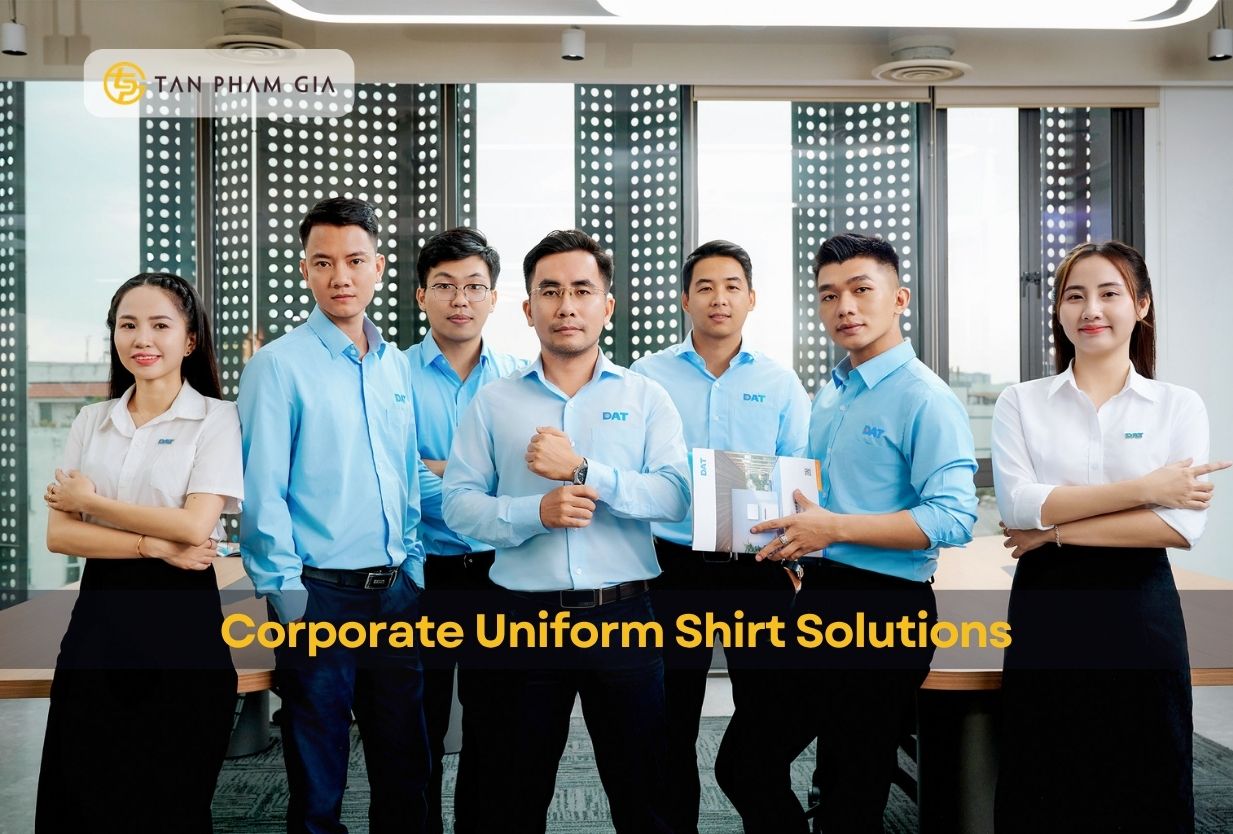
Based on the project visuals, DAT’s brand colors are incorporated into the uniform designs, while the DAT logo is positioned on the chest to create a clear point of brand recognition without making the garment visually complicated.
For the shirt design, details such as the collar, button placket, chest pocket, and logo are coordinated as part of the overall design. The blue color used on the shirt also creates a visual connection with DAT’s brand identity.
Key design details include:
- DAT logo positioned on the chest.
- Clean, structured collar design.
- Button placket using coordinated buttons.
- Chest pocket placement.
- Shirt color aligned with the brand identity.
In addition to the shirt, the project visuals also show other garment options using DAT’s color palette and branding elements. This demonstrates how uniform designs can be adapted across different garment styles while maintaining consistent brand recognition.
How Was the Fabric Selected?
Fabric is an important part of uniform development because it directly affects wearer comfort and the practical performance of the garment.
Tan Pham Gia presents fabric options to help businesses make decisions based on actual usage requirements. The consultation goes beyond simply naming a fabric and focuses on identifying which material is appropriate for the intended application.
Businesses can consider:
- Wearing comfort: Is the fabric suitable for the expected wearing duration and frequency?
- Garment structure: Does the fabric support the intended silhouette and shape retention?
- Working environment: Is the material suitable for the actual conditions in which employees will wear it?
- Brand presentation: Does the fabric surface and color support the required design?
The key point is that there is no single fabric suitable for every uniform requirement. Businesses should select materials based on garment style, working environment, frequency of use, and brand presentation requirements.
Results of the DAT Group Uniform Project
The key outcome of the project was a consistent relationship between garment design, color, and DAT Group’s brand identity.
The DAT logo was incorporated directly into the garments together with the brand’s signature colors. The garment details followed a consistent design direction, creating a cohesive appearance across the uniform program.
From the wearer-experience perspective, the development process also considered practical employee requirements. This is particularly important when uniforms are worn regularly in a corporate environment.
The DAT Group case study highlights four key considerations when developing uniform shirts:
- Brand identity: Colors and logos should be incorporated clearly and proportionally.
- Purpose-driven design: The garment style should match the working environment and corporate image.
- Fit-for-purpose fabric: Fabric should be evaluated according to its intended use rather than selected solely by name or initial appearance.
- Consistency: Colors, logos, garment construction, and design details should remain consistent throughout the uniform program.
The DAT Group case study demonstrates that corporate uniform shirts are more than simply garments. To create an effective uniform program, businesses should begin with their actual requirements and then determine the appropriate design, fabric, and branding approach.
This approach allows uniforms to support both corporate image requirements and long-term employee wearability.
Frequently Asked Questions About Uniform Shirts
Questions 1. Are Uniform Shirts Suitable for Every Industry?
Uniform shirts are suitable for many industries, but fabric and garment construction should be adjusted according to the working environment. For example, premium offices and financial institutions may prioritize soft, wrinkle-resistant fabrics, while service environments may require more durable and easy-care materials.
Questions 2. Which Fabric Is Suitable for Premium Office Uniform Shirts?
Polyspun with antibacterial properties can be considered for uniform shirts used by employees who frequently interact with customers, particularly when wrinkle resistance and a polished appearance are priorities. For more active working environments, businesses may also consider Cool & Dry fabric options.
Questions 3. Can Uniform Shirts Be Designed Separately for Men and Women?
Yes. Uniform shirts can be developed with separate men’s and women’s fits while maintaining consistency in color, logo placement, and other brand identity elements.
Questions 4. What Should Businesses Prepare Before Ordering Bulk Uniform Shirts?
Businesses should determine the required quantity, design and brand identity, fabric and garment style, men’s and women’s size distribution, logo printing or embroidery method, and sample approval requirements before starting bulk production.
Questions 5. Is the Cost of Uniform Shirt Manufacturing Fixed?
No. Uniform shirt manufacturing costs depend on order quantity, fabric, garment construction, finishing requirements, logo printing or embroidery, packaging specifications, and other project requirements.
Contact Tan Pham Gia at 0843 406 406 to discuss your requirements and receive a project-specific quotation.
Questions 6. Does Tan Pham Gia Manufacture Uniform Shirts Based on Custom Designs?
Yes. Tan Pham Gia provides consultation and manufactures uniform shirts based on each company’s custom design, brand identity, and specific working environment.
Uniform shirts can be suitable for a wide range of business environments, but the same specification should not be applied to every industry. Businesses should consider the working environment, wearer experience, brand identity, and budget before selecting a uniform solution.
Fabric selection should also reflect the specific requirements of each employee group:
- Frequent customer and partner interaction: Polyspun, with a focus on shape retention and wrinkle resistance.
- Active and outdoor environments: Dry Cool, with breathability and quick-drying performance.
- Natural comfort and moisture absorption: 100% Cotton.
- Corporate and office environments: Bamboo, Kate, or Modal can be considered depending on desired hand feel, performance requirements, and budget.
Selecting the right uniform shirt solution from the beginning can help businesses maintain consistency, optimize long-term usage costs, and reduce potential issues during bulk production.
Looking for uniform shirts that match your working environment and brand identity? Share your required quantity, design direction, and usage requirements with Tan Pham Gia. Our team can recommend suitable fabrics, styles, production specifications, and provide a project-specific quotation via Hotline / Zalo: 0843 406 406 or the contact form below.