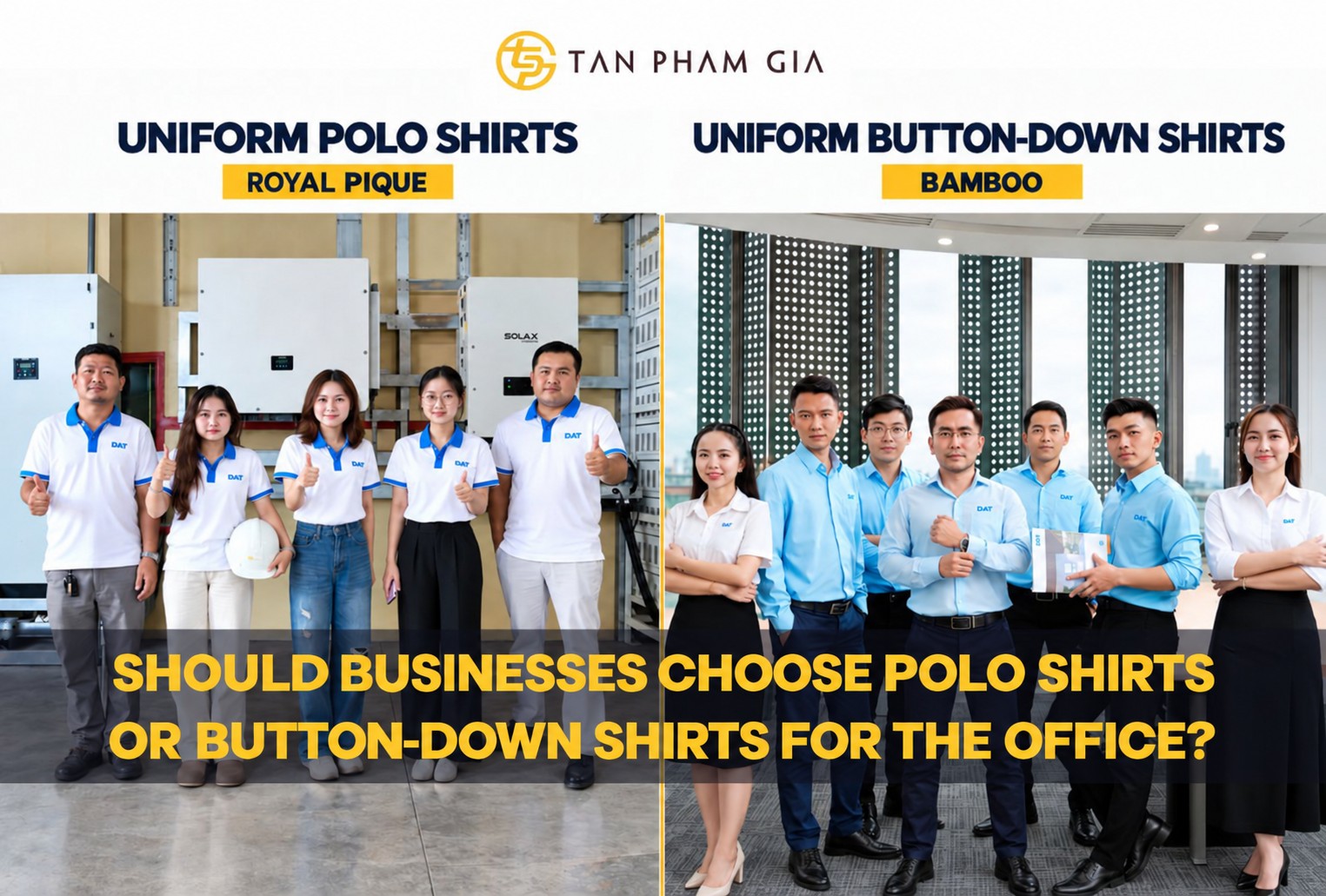
Whether a business should choose polo shirts or button-down shirts for company uniforms depends on its corporate culture, the nature of employees’ work, and the brand image it wants to present. Polo shirts suit dynamic environments where employees need comfort throughout the workday, while button-up shirts are better suited to roles that require a more polished and formal appearance.
This guide from Tan Pham Gia Uniform compares the two garment types, presents three implementation options, and explains the criteria businesses should consider from the beginning, particularly when ordering uniforms in bulk.
Polo Uniform Shirts – A Flexible Solution for Dynamic Office Environments
Polo uniform shirts balance a professional appearance with everyday comfort. They suit businesses that want to present a youthful, flexible image while maintaining a neat appearance when employees meet customers or business partners.
Design and Style Characteristics of Polo Uniform Shirts
A polo shirt has a collar, a pullover body, and a short button placket at the chest. It may have short or long sleeves depending on the intended use. This familiar construction creates a professional appearance without feeling overly formal, making it suitable for modern office environments.
For brand presentation, a polo shirt provides clear areas for an embroidered or printed logo on the left chest, sleeve, or back. Businesses can also use contrast colors on the collar and sleeve cuffs to create a recognizable design without making the garment unnecessarily complex.
Advantages of Polo Shirts in the Office
One of the main advantages of a polo shirt is that it can remain comfortable during extended wear while still presenting a professional appearance. Piqué knit and other knitted fabrics are often selected because they can support movement and suit employees who work across different locations. Actual comfort, stretch, and ventilation should still be evaluated using the selected fabric and completed sample.
- Comfortable and easy to move in, making polo shirts suitable for employees who travel frequently or meet customers outside the office.
- Relatively easy to care for, with less ironing generally required than for a formal button-up shirt.
- Flexible for brand presentation because printed or embroidered logos can be positioned naturally on the garment.
- Suitable for different ages and body types when the correct fit and size chart are selected.
- Practical for large-volume production because of the relatively streamlined garment structure and quality-control process.
Positions Suited to Polo Uniform Shirts
Polo shirts suit employee groups that need flexibility in their everyday work, particularly those who frequently interact with customers outside the office.
- Sales, customer-service, and service-consultation employees.
- Marketing, event, and outdoor-activity teams.
- Operations, logistics, and technical personnel working between the office and field locations.
- Office employees in businesses with a youthful and open corporate culture.
- Teams participating in conferences, team-building programs, and internal activities.

Button-Up Uniform Shirts – A Polished Choice for a Professional Corporate Image
Button-up uniform shirts suit businesses that prioritize formality, professionalism, and discipline in the workplace. This traditional garment can create a reliable first impression when employees meet customers and business partners.
Design and Style Characteristics of Button-Up Uniform Shirts
A button-up shirt has a structured or turn-down collar and a full-length front button placket. It may have short or long sleeves. Its construction and fit generally require more detailed pattern development and sewing than a polo shirt, creating a neater and more formal overall appearance.
This style coordinates easily with tailored pants, skirts, blazers, and outerwear, allowing businesses to create a complete uniform system for both men and women. The logo is often embroidered on the left chest, with subtle branded details added to the collar or cuffs where appropriate.
Advantages of Button-Up Shirts in the Office
Button-up shirts create a clearly professional image and help employees appear polished without requiring many additional accessories. For industries involving direct contact with high-value customers, business partners, or formal organizations, this garment can communicate respect and professionalism.
- Formal and dependable appearance in corporate communication.
- Easy to coordinate with blazers, vests, ties, scarves, and other uniform garments.
- A well-developed fit can create clean lines for different body types.
- Available in various fabric options, including cotton and blended materials, depending on the climate and working conditions.
- Suitable for the dress-code requirements of corporations, banks, financial institutions, and other formal organizations.
Positions Suited to Button-Up Uniform Shirts
Button-up shirts are commonly selected for roles representing the brand or working in formal environments.
- Reception, administration, human resources, and office-management teams.
- Finance, banking, insurance, and consulting professionals.
- Managers, supervisors, and department leaders.
- Employees in premium service environments such as hotels, events, and showrooms.
- Employees who frequently attend meetings, negotiations, and partner-facing activities.

Detailed Comparison of Polo and Button-Up Company Uniforms
When comparing polo and button-up uniforms, the main differences are their level of formality, comfort, and suitability for specific roles. Polo shirts emphasize flexibility, while button-up shirts emphasize a polished appearance. Neither option is suitable for every business.
Brand Style and Image
Button-up shirts create a formal and conventional appearance, making them suitable for brands that want to communicate reliability and traditional professionalism. Polo shirts create a more approachable and modern image, making them suitable for brands with a dynamic and open culture.
The selected garment should align with the brand’s tone. A young technology company may find polo shirts more appropriate, while a financial or consulting organization may prefer button-up shirts to communicate stability.
Comfort and Flexibility During Work
Polo shirts are generally more flexible because they are usually made from knitted fabrics such as piqué. Their construction can provide more movement around the neck and shoulders, depending on the selected fabric and fit. Employees who travel frequently, work outdoors, or handle different activities during the day may find polo shirts more practical.
Button-up shirts require greater attention to fit, fabric, and ventilation to remain comfortable throughout the workday. With an appropriate fabric and garment structure, they can still provide a suitable wearing experience while maintaining a formal appearance.
Suitability for Different Roles and Office Activities
Polo shirts can be used across many employee groups and activities, including events, team-building programs, fieldwork, sales, and informal office environments. Button-up shirts are generally more suitable for customer reception, negotiations, formal meetings, and roles requiring a more polished appearance.
In practice, businesses often classify uniforms according to job responsibilities instead of using one garment type for every employee. This approach maintains consistent branding while meeting the needs of individual departments.
Fabric, Fit, and Garment-Care Requirements
Polo shirts commonly use piqué or other knitted fabrics. They are generally easier to care for and often require less ironing, making them practical for regular rotation across a large workforce. Their fit can also accommodate a wider range of body types when supported by an appropriate size chart.
Button-up shirts require more precise garment structure and sewing. They usually need ironing to maintain a neat appearance. Businesses should therefore consider employees’ garment-care conditions, especially when implementing uniforms in large quantities.
Polo and Button-Up Uniform Comparison Table
Three Uniform Options for a Professional Office Environment
A business can choose one of three options: polo shirts for all employees, button-up shirts for all employees, or a combination of both based on job roles. Each option supports a different corporate direction and should be evaluated before large-volume production.
Option 1 – Choose Polo Uniform Shirts for the Workforce
This option suits businesses that prioritize a dynamic image and everyday flexibility, particularly when employees work across multiple locations. Polo shirts are practical for daily wear and help maintain a coordinated appearance without making employees feel overly restricted.
When implementing this option, businesses should consider:
- Design: Select the collar, sleeve cuffs, and colors according to the brand identity.
- Fabric: Prioritize a material suited to the working environment and evaluate its structure after repeated care.
- Brand presentation: Standardize the logo placement and dimensions across all shirts.
Option 2 – Choose Button-Up Uniform Shirts for the Workforce
This option suits businesses that prioritize a polished appearance and have clear workplace dress requirements. Button-up shirts create strong visual consistency and work well in corporate offices and premium service environments.
When implementing this option, businesses should consider:
- Fit: Use appropriate men’s and women’s fits to accommodate different body types.
- Fabric: Select a fabric that supports the required garment structure and wearing conditions while considering wrinkling and ventilation.
- Coordination: Determine whether the shirts will be combined with pants, skirts, blazers, or other outerwear.
Option 3 – Combine Polo and Button-Up Shirts by Employee Group
A combined approach suits businesses with several departments and different working conditions. Office employees may need a more polished appearance, while sales or operations teams may require greater flexibility.
To implement this option effectively, businesses should:
- Assign each garment type according to the department, role, and nature of the work.
- Establish consistent rules for when the uniforms are worn, how they are coordinated, and how they should be cared for.
- Standardize the colors, logo, and main brand details across both garment types.
Does your business have multiple departments and need help deciding between polo and button-up uniform shirts? Contact Tan Pham Gia Uniform for recommendations based on job requirements, workforce size, and brand direction.
How to Choose the Right Shirt for a Professional Office Environment
To choose the right garment, businesses should begin with the brand image, classify employee roles, select suitable fits, prepare the size chart, and approve a physical sample. Following this order helps reduce problems during bulk production.
Define the Brand Image and Corporate Culture
The first step is determining what the brand wants to communicate: traditional professionalism or a youthful and open image. The company’s level of formality, dress code, and industry characteristics should also be considered.
Management and Human Resources should discuss these requirements before making a decision. Early agreement reduces later changes, particularly when uniforms will be implemented across multiple branches.
Classify Job Roles and Uniform Requirements
Employee groups work in different conditions, ranging from fixed office positions to roles involving regular travel. Classification helps determine which groups require formality and which need greater comfort and flexibility.
Businesses should prepare a role table covering each department, frequency of customer interaction, working conditions, and number of uniform days per week. This provides a clearer basis for selecting polo shirts, button-up shirts, or a combination of both.
Select Fits Suitable for Different Body Types
The garment fit should accommodate different body types within the same workforce.
For button-up shirts, separate men’s and women’s fits are often required to achieve an appropriate fit around the shoulders, chest, and waist. For polo shirts, businesses should check the body length, shoulder width, and sleeve-cuff fit so that the garment remains neat without feeling restrictive.
Develop a Size Chart and Bulk-Order Plan
For a large order, an appropriate size chart directly affects how well the garments fit across the workforce. Businesses should collect employee sizing information, compare it with the supplier’s size chart, and plan a reasonable reserve for necessary exchanges.
The implementation plan should also define the main stages: sample approval, size collection, production, inspection, and delivery. If the company expects to recruit additional employees, the approved sample and specifications should be retained for future orders.
Approve a Physical Sample Before Bulk Production
Approving a physical sample allows the business to inspect the fabric, color, fit, logo, and actual wearer experience. Employees with different body types should try the sample before final approval.
Criteria to check include:
- Whether the color matches the approved reference and remains consistent across garment details.
- Whether the printed or embroidered logo is clear and uses the correct position and dimensions.
- Whether the seams, collar, and buttons are secure and neatly finished.
- How the garment feels after being worn for several working hours.
Should You Choose Polo Shirts or Button-Down Shirts for Company Uniforms?
No single shirt type is suitable for every business. The correct choice depends on actual operational requirements.
- Choose polo shirts when flexibility, a dynamic image, and everyday practicality are the main priorities.
- Choose button-up shirts when the role requires a polished and formal professional appearance.
- Combine both when the business has several employee groups with different clothing requirements.
If the business is still deciding between the options, it can classify employee roles and approve samples of both garment types before confirming the production quantities. This helps reduce the cost and disruption of later revisions.
Fabric Is Also an Important Factor When Selecting Uniforms
Fabric affects wearer experience, color appearance, garment structure, and how the uniform looks after repeated care. Businesses should therefore select the material after determining the garment type and working environment.
Selecting Polo Shirt Fabrics According to the Working Environment
For office environments, CoolDry Pique™ can be considered for frequently worn polo uniforms requiring a polyester piqué structure. Its composition is 100% Polyester with a weight of 240 GSM. Any breathability or quick-drying requirement should be evaluated using the selected fabric and a physical sample.
CottonFlex™, containing 35% Cotton and 65% Polyester at 270 GSM, can be considered for businesses comparing a cotton-and-polyester blend with other office polo materials.
For field-based or higher-movement teams, Royal Pique™, made from 100% Polyester at 270 GSM, provides a more substantial piqué option for evaluation where a structured appearance is required.
For management or premium corporate programs, Soft Pique™, containing 60% Cotton and 40% Polyester at 210 GSM, is included in the TPG Signature™ group and can be considered based on the desired surface and garment appearance.
Composition and GSM do not independently confirm breathability, colorfastness, shrinkage, or long-term shape retention. These characteristics should be assessed through an approved sample and agreed testing or care conditions.
Selecting Button-Up Shirt Fabrics According to Fit and Brand Image
Polyspun can be considered for office, reception, and sales shirts where the business requires a structured appearance. Because Polyspun is a trade name rather than a complete technical specification, the actual composition and performance should be confirmed for the selected fabric code.
100% Cotton may be considered for indoor working environments where the business prioritizes a natural fiber. The fabric’s weight, weave, shrinkage, and care requirements should still be evaluated.
Bamboo-based fabric may provide a lighter or softer hand depending on its actual composition and construction. The percentage of bamboo-derived fiber and other blended fibers should be confirmed before approval.
Kate is another trade-name fabric group commonly considered for administrative and service shirts. Its precise composition, surface, and care requirements depend on the selected fabric.
Modal may be considered when the business wants a softer fabric with more fluid drape. Its suitability still depends on composition, weave, garment structure, and care requirements.
Dry Cool is a trade name that may be considered for mobile employees, but ventilation and drying performance should be confirmed using the exact fabric specification and sample.
Check Comfort, Shape Retention, and Care Requirements
Before selecting a fabric, businesses should inspect physical samples rather than relying only on photographs or descriptions. Sample washing and wearer trials can help identify possible dimensional change, color variation, pilling, or fit issues.
The review should consider ventilation, stretch, wrinkling, color stability, garment structure, and care requirements in relation to employees’ actual washing practices.
Businesses can also review the TPG Fabric Collection™ and the corporate polo uniform solution for additional information.
Professional Polo and Button-Up Uniform Manufacturing at Tan Pham Gia Uniform
Tan Pham Gia Uniform supports businesses from garment-style consultation through finished-product delivery. The company has more than 23 years of experience in the fashion and apparel industry, has worked with over 500 businesses, and has produced more than 1,000,000 garments.
Tan Pham Gia Uniform applies Golden Ratio design principles together with traditional draping and fit refinement directly on a dress form to develop garments for different body types.
Support for businesses includes:
- Recommending garment types according to the office environment and the responsibilities of each employee group.
- Recommending fabrics, fits, colors, and brand-application options.
- Coordinating design, specification, and physical-sample approval before bulk production.
- Supporting uniform implementation according to the required quantity and corporate supply plan.
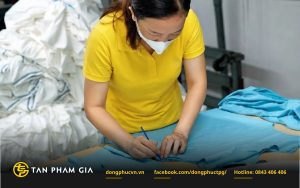
Businesses can provide their workforce size, employee groups, usage requirements, and design direction so Tan Pham Gia Uniform can recommend an approach aligned with the actual implementation needs.
Frequently Asked Questions About Polo and Button-Up Uniform Shirts
Questions 1. Should a Company Choose Polo or Button-Up Shirts for Its Uniforms?
The choice depends on the corporate culture and nature of the work. Polo shirts suit dynamic environments requiring comfort and flexibility. Button-up shirts suit roles that prioritize a polished and formal appearance.
If the business has several employee groups, the two garment types can be assigned by department.
Questions 2. Are Polo Shirts Formal Enough for Office Uniforms?
Yes, when the appropriate fabric, fit, color, and logo application are selected. A structured piqué polo with a neat collar and clearly finished logo can create a professional appearance.
For positions requiring a higher level of formality, the business may choose button-up shirts or combine both garment types.
Questions 3. Can Polo and Button-Up Shirts Be Used in the Same Company?
Yes. The business should classify employees according to job requirements and standardize the colors, logo, and uniform rules across the groups.
This allows each department to use suitable clothing while maintaining a consistent brand identity.
Questions 4. Which Fabrics Are Suitable for Polo and Button-Up Uniform Shirts?
Polo uniforms commonly use piqué knits and cotton blends, depending on the intended working environment. Button-up shirts may use Polyspun, Kate, cotton, bamboo-based fabrics, or modal, depending on the required fit and appearance.
Businesses should approve the actual fabric sample and confirm its composition and specifications before production.
Questions 5. What Should a Business Prepare for a Large Uniform Order?
The business should prepare the number of employees by role, sizing information, logo and primary brand colors, usage requirements, and the implementation plan.
This information helps the manufacturer recommend an appropriate garment type, fabric, size structure, and production process.
Whether a business should choose polo shirts or button-down shirts for company uniforms depends on its brand image, working environment, and the responsibilities of each employee group. Polo shirts provide greater flexibility, button-up shirts create a more polished appearance, and a combined approach can accommodate different requirements within the same organization.
For project-specific guidance, contact Tan Pham Gia Uniform at +84 843 406 406 or submit the consultation form.