When businesses receive several custom polo uniform quotes for the same order, each supplier may propose a different price, making it difficult to understand what causes the variation. This usually happens because the quotes are not based on the same fabric, fit, logo specifications, size breakdown, or supply scope. Comparing only the quoted price can therefore lead to an inaccurate conclusion.
This guide from Tan Pham Gia Uniform explains how procurement teams can review each item in a quotation, distinguish unit price from total project cost, and build a standardized supplier-comparison table. A consistent review process makes internal approval clearer, reduces unexpected costs during bulk production, and allows suppliers to be evaluated using the same criteria.
Why Do Custom Polo Uniform Quotes Differ for the Same 1,000-Shirt Order?
Custom polo uniform quotes differ because suppliers may calculate their prices using different product specifications, supply scopes, and commercial terms. The difference is not necessarily caused by production cost alone.
If a business compares suppliers only by the final price, the most important differences may be hidden in the quotation details.
For example, a company sends the same request – “1,000 polo uniform shirts with a logo on the left chest” – to three suppliers:
- The first supplier proposes polyester piqué fabric, an embroidered logo, and packaging sorted by size.
- The second proposes a cotton-blend fabric and a printed logo but excludes shipping.
- The third proposes a similar garment but will only develop a physical sample after the order is confirmed.
These three quotations cannot be compared fairly until their specifications and supply scope are standardized.
The Same Quantity Does Not Always Mean the Same Product Specification
“1,000 polo shirts” only defines the total quantity. It does not provide enough information to establish a complete product specification.
Custom polo shirt pricing may also depend on:
- Fabric composition and weight.
- Men’s, women’s, regular, or slim fit.
- Base color and contrast details on the collar and sleeve cuffs.
- Size breakdown.
- Logo specifications and application method.
- Packaging requirements.
- Required delivery schedule.
When any of these elements changes, the unit price and cost structure may also change. Before requesting quotations, the business should create one standardized brief and send the same version to every supplier.
Fabric Specifications May Not Be Equivalent
Comparing fabrics only by name is not sufficient. Two fabrics described as polyester piqué may differ in weight, surface texture, construction, and wearer experience.
For example, within Tan Pham Gia Uniform’s fabric system:
- Royal Pique™: 100% Polyester, 270 GSM.
- CoolDry Pique™: 100% Polyester, 240 GSM.
GSM refers to the weight of the fabric in grams per square meter and provides a relative indication of fabric weight and thickness.
For an accurate comparison, businesses should ask each supplier to confirm:
- Fabric code or technical designation.
- Fiber composition and percentage.
- Fabric weight in GSM.
- Color and corresponding color code or physical swatch.
- Any technical performance criteria the supplier commits to in writing.
This information should be checked against a physical fabric sample rather than evaluated only through a written description.
Size Breakdown and Garment Fit May Differ
Size breakdown and fit can affect the quotation because standard sizes, separate men’s and women’s fits, special sizes, and individually adjusted garments may require different fabric consumption and production planning.
Two quotations do not cover the same scope if one includes only a standard size range while the other includes oversized or special sizes.
The uniform brief should clarify:
- Whether men’s and women’s fits are separate or one unisex fit is used.
- The smallest and largest required sizes.
- The number of garments outside the standard size range.
- Workforce composition and body-type requirements.
- Any employee groups requiring individual sizing, such as management.
The more accurately the size breakdown reflects the workforce, the less likely the quotation will need to be revised after approval.
Logo Specifications Affect the Quoted Configuration
The logo is part of the product specification. The quotation should state the number of logos, locations, dimensions, colors, and printing or embroidery method.
A quotation that only says “logo included” cannot be compared accurately with another supplier’s proposal.
For example, one embroidered logo on the left chest is a different configuration from an order with additional embroidery on the sleeve or back. A multicolor logo with small details may also require a different application method from a simple single-color logo.
The business should provide the original logo file and ask each supplier to document the application specifications in the quotation.
Supply Scope and Commercial Terms May Differ
Supply scope is easily overlooked. Some quotations include sample development, packaging, shipping, and related services, while others cover only basic garment production.
Two prices may initially appear similar even though they include different scopes of work.
Commercial terms should also be reviewed, including:
- Payment terms.
- Quotation validity.
- VAT and invoicing.
- Conditions for price adjustments.
- Delivery and acceptance terms.
These conditions should be entered into the same comparison table to prevent suppliers with different scopes from being treated as directly equivalent.

Standardize Your Uniform Brief with Tan Pham Gia Uniform
Businesses can provide order quantity, workforce structure, fabric requirements, logo files, delivery location, and required delivery date so Tan Pham Gia Uniform can help standardize the brief before preparing a quotation.
What Is the Difference Between Unit Price and Total Project Cost?
Unit price is the cost of one polo shirt based on an agreed configuration. Total project cost is the full budget the business must approve, including items that may not be included in the price of each garment.
Procurement teams need the unit price for supplier comparison, while management generally needs the total project cost for budget approval.
If the business looks only at the unit price, it may overlook logo application, packaging, shipping, or costs resulting from later order changes. Each quotation should therefore be reviewed at two levels:
- Unit price based on the agreed garment specification.
- Total cost based on the complete supply scope.
Which Product Configuration Determines the Unit Price?
The unit price is determined by the agreed product specifications and order conditions. It is not a fixed amount that applies to every polo uniform project.
Factors affecting custom polo uniform pricing commonly include:
- Order quantity: Quantities such as 100, 200, 300, 500, or 1,000 shirts may require different material purchasing and production arrangements.
- Fabric specification: Composition, GSM, color, and selected fabric code.
- Fit and size range: Men’s and women’s fits, special sizes, and individual adjustments.
- Garment construction: Collar design, sleeve cuffs, seams, and finishing details.
- Logo and personalization: Number of logo locations, printing or embroidery, and individual employee names.
- Packaging: Bulk packaging or sorting by size, department, or branch.
- Required schedule: The delivery date specified in the project plan.
Because custom polo uniform prices depend on the selected configuration, Tan Pham Gia Uniform prepares project-specific quotations rather than publishing one standard price for every order.
Which Costs Are Included in the Quotation?
Businesses should confirm which costs are included instead of assuming that every related item has already been calculated. Items to check include:
- Garment production.
- Logo printing or embroidery.
- Sample development.
- Packaging and sorting.
- Shipping.
- Taxes and invoicing.
- Special delivery requirements, such as phased or multi-location delivery.
Every item should be marked as one of the following:
- Included.
- Excluded.
- Quoted separately.
If the quotation does not clearly state the status of an item, the business should request written confirmation.
Which Additional Costs May Arise?
Additional costs commonly appear when the order configuration changes after the quotation has been issued.
Before approving the quotation, the business should ask how the supplier will handle:
- A change in fabric or color.
- Design revisions after sample development.
- Additional logos or changes to logo dimensions.
- Sizes outside the original scope.
- A change in order quantity.
- A shortened production schedule.
- Changes to delivery locations or methods.
Agreeing on adjustment principles before production helps prevent disputes later in the project.
Why Does a Lower Unit Price Not Always Produce a Lower Total Cost?
A lower unit price may exclude services or requirements that must later be added to the project budget.
For example, a quotation that excludes shipping or size-sorted packaging may appear less expensive until these costs are included in the final budget.
When comparing custom polo uniform quotes, procurement teams should compare the estimated total cost across the same supply scope rather than ranking suppliers only by price per shirt.
How to Standardize Multiple Quotes in One Comparison Table
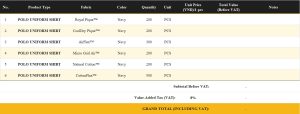
The most effective way to compare suppliers is to enter every quotation into one matrix using the same criteria, product configuration, and supply scope.
Suppliers often present custom polo shirt pricing in different formats. Without standardization, a business may unintentionally compare products and services that are not equivalent.
The process has three main stages:
- Standardize the request-for-quotation documents.
- Record every required field.
- Bring each quotation back to the same configuration.
Standardize the Request Before Sending It to Suppliers
A complete request produces quotations that are easier to compare. The same brief should be sent to every supplier and should specify:
- Estimated quantity.
- Intended wearer groups.
- Garment fit.
- Size breakdown.
- Selected fabric or usage requirements.
- Color specifications.
- Logo and application locations.
- Packaging requirements.
- Delivery locations.
- Required delivery date.
- Inspection and acceptance criteria.
If the business has not selected a specific fabric, it can describe the working environment and daily wearing conditions. Suppliers can then recommend options, after which one common specification should be selected for the final quotation round.
Information Required in a Supplier Comparison Table
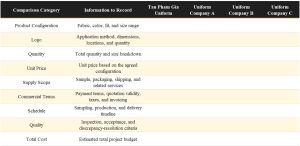
The comparison table should include enough information for the approver to understand the product, cost, scope, and conditions offered by each supplier.
Each supplier should be assigned a separate column so the approver can read across each criterion and identify differences quickly.
Record Assumptions and Exclusions
Items that have not been quoted, confirmed, or included in the supplier’s scope should be recorded separately. They should not be left blank.
A blank cell may be interpreted as:
- Included.
- Not applicable.
- Not yet confirmed.
Each interpretation can lead to a different conclusion.
Add an “Assumptions and Exclusions” row for every supplier. This row should document the conditions on which the quotation is based, such as an assumed size distribution or an item that will be quoted separately.
Normalize the Product Configuration Before Comparing Prices
A quotation should only be considered higher or lower after every supplier has quoted an equivalent product, supply scope, and delivery arrangement.
If a quotation uses a different configuration, ask the supplier to revise it instead of estimating the difference internally.
Once the quotations have been normalized, procurement teams can compare unit price and total cost fairly while also reviewing:
- Production capacity.
- Quality-control procedures.
- Schedule management.
- Sample-development process.
- Ability to support future repeat orders.
Discuss Your Quotation Comparison
If your business has received several quotations and needs to review the configurations before approval, contact Tan Pham Gia Uniform for assistance in building a standardized comparison table.
Five Items Businesses Should Review in Custom Polo Uniform Quotes
Before approving a quotation, businesses should review five areas: technical configuration, quantity and sizing, logo specifications, cost scope and commercial terms, and schedule and quality control.
1. Technical Configuration of the Polo Shirt
The quotation should document the technical configuration agreed upon in the brief rather than relying on general descriptions. Review:
- Fabric composition and GSM.
- Color and color code.
- Men’s, women’s, or unisex fit.
- Collar and sleeve-cuff construction.
- Seams and finishing details.
- Any requirements specific to the intended working environment.
2. Quantity, Size Breakdown, and Size-Management Plan
The quotation should confirm the total quantity, quantity by size, size-collection method, and procedure for exceptional cases.
Ask the supplier:
- How employee sizes will be collected and consolidated.
- Whether a size chart and fitting samples will be provided.
- How special sizes or newly hired employees will be handled.
- What procedure applies if sizing discrepancies occur.
- Whether future size replenishment is supported.
3. Logo and Brand-Identity Specifications
The quotation should document the logo file, colors, dimensions, location, and application method. A physical logo sample should be developed on the actual production fabric.
The same logo can appear differently on different fabric surfaces. Marketing or communications personnel should therefore participate in the approval process because the logo directly affects brand presentation.
4. Cost Scope and Commercial Terms
The quotation should clarify the unit price, total value, taxes, payment terms, validity period, and conditions for price changes. Check:
- Which product configuration the unit price covers.
- Which items are included in the total.
- VAT and invoice treatment.
- Payment schedule.
- Quotation validity.
- Circumstances that may result in a revised price.
5. Schedule, Quality Control, and Acceptance
The quotation should identify the expected stages for:
- Sample development.
- Sample approval.
- Bulk production.
- Quality inspection.
- Delivery.
- Product acceptance.
A complete quotation should explain not only how much the project costs, but also when each stage will occur and which criteria will be used for acceptance.
The supplier should also document how discrepancies from the approved sample will be handled.
Checklist Before Approving Custom Polo Uniform Quotes
Before submitting a quotation for approval, businesses should complete three checklists: internal requirements, quotation documents, and the final approval package.
Internal Requirements and Order Scope
- Has the intended department confirmed the purpose and working environment?
- Are the total quantity and workforce structure current?
- Have the project budget and approval authority been defined?
- Has Marketing approved the brand-identity requirements?
- Are the delivery locations and required delivery date confirmed?
Quotation Documents
- Are all suppliers quoting the same product configuration?
- Have the fabric code and specifications been confirmed?
- Does the quotation state the logo method, size, and location?
- Which costs are included in the unit price?
- Are there unquoted or potentially additional costs?
- Are tax, payment, and quotation-validity terms clear?
- Have the sampling, production, and delivery stages been confirmed?
Final Approval Package
A complete approval package should include:
- The agreed brief or technical requirements.
- Supplier-comparison table.
- Official quotations.
- Fabric samples or material documentation.
- Logo presentation on the garment.
- Sampling and delivery plan.
- Assumptions, exceptions, and project risks requiring management approval.
Review Completed Uniform Projects
Businesses can review projects completed by Tan Pham Gia Uniform to understand how a uniform order progresses from the initial brief and proposed solution to production and delivery.
From Quotation Approval to Physical Sample Approval
Approving the quotation and approving the physical polo sample are two different decisions.
Quotation approval confirms the budget and commercial terms. Sample approval confirms the actual product. Separating these stages prevents a business from approving the price before discovering that the fabric, fit, or logo does not meet expectations.
Quotation Approval Confirms the Budget and Commercial Terms
Quotation approval confirms:
- Product configuration.
- Supply scope.
- Total project budget.
- Commercial conditions.
- General implementation requirements.
At this stage, the business has not yet evaluated the complete physical garment. Every requirement should therefore be documented for use during sample development and production.
The official quotation and approved brief should be retained together. If changes occur later, these documents provide the baseline for determining which items require adjustment.
Sample Approval Confirms the Actual Product
The physical polo sample should be evaluated for:
- Fabric and color.
- Fit and measurements.
- Collar and sleeve cuffs.
- Seams and finishing.
- Logo color, dimensions, and placement.
- Wearer experience.
- Suitability for the brand image.
Wearer feedback should be collected from representatives working in different environments. The same garment may feel different to office employees and employees working outdoors.
Consolidate Sample Feedback Through One Point of Contact
The business should assign one person or department to consolidate feedback from Procurement, Administration and Human Resources, Marketing, and management.
If each department sends separate comments directly to the supplier, requirements may conflict and extend the approval process.
The designated contact should submit one consolidated revision request and issue the final approval.
Lock the Approved Sample as the Production Reference
The approved sample should be locked as the physical reference for production, inspection, and acceptance.
Both parties should confirm the reference sample and document:
- Fabric.
- Color.
- Fit.
- Logo specifications.
- Construction and finishing details.
Bulk-produced garments should be compared with this approved sample instead of being evaluated only against verbal descriptions.
Reconfirm Quantity, Sizes, and the Delivery Plan
Before bulk production begins, both parties should lock the final versions of:
- Size breakdown.
- Total quantity.
- Delivery locations.
- Packaging requirements.
- Delivery plan.
This is the final stage at which newly hired employees or size-distribution changes can usually be incorporated with limited disruption.
Changes submitted after the order is locked should be handled according to the adjustment terms documented in the quotation.
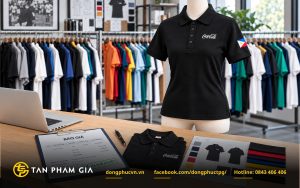
Tan Pham Gia Uniform’s Bulk Corporate Polo Shirt Solutions
Tan Pham Gia Uniform provides corporate uniform solutions for B2B clients, supporting projects from brief clarification through final delivery. This is particularly relevant to large orders requiring consistent quality and brand presentation.
With more than 23 years of apparel-industry experience, partnerships with over 500 businesses, and more than 1,000,000 garments produced, Tan Pham Gia Uniform has developed a process that helps procurement teams monitor each project stage.
>>> See also: Uniform Polo Shirts Solutions | Corporate Uniforms
Consultation Based on Usage Requirements and Project Budget
Tan Pham Gia Uniform begins by reviewing:
- Intended wearer groups.
- Working environment.
- Brand requirements.
- Quantity and size structure.
- Project budget.
- Delivery requirements.
This approach helps businesses select an appropriate product configuration instead of choosing solely by the lowest quoted price.
Tan Pham Gia Uniform’s material system is organized around different operating environments:
- TPG Prime™: Factories, logistics, food and beverage operations, and retail chains.
- TPG Airsoft™: Spas, cafés, showrooms, restaurants, service teams, and events.
- TPG CottonFlex™: Offices, education, healthcare, and service environments.
- TPG AirPique™: Team-building programs and corporate sports activities.
- TPG Signature™: Leadership teams, premium corporate programs, resorts, and hotels.
The selected material and its specifications should still be verified using the corresponding fabric code, technical information, and physical sample.
Standardizing the Configuration Before Quotation
Before issuing the official quotation, Tan Pham Gia Uniform works with the business to clarify:
- Fabric.
- Fit.
- Size range.
- Logo specifications.
- Packaging.
- Required delivery schedule.
- Supply scope.
This standardization helps the quotation accurately reflect the selected configuration and makes it easier to include in a supplier-comparison table.
Tan Pham Gia Uniform’s standard process includes seven stages:
- Requirement consultation.
- Style and fabric selection.
- Design development.
- Sample approval.
- Bulk production.
- Quality inspection.
- Delivery.
The main product configuration is established during the initial stages to reduce later revisions.
Developing and Approving the Physical Sample
Tan Pham Gia Uniform develops a sample based on the agreed configuration, receives consolidated feedback from the business, and locks the approved garment as the production reference.
Traditional draping and fit refinement directly on a dress form, combined with Golden Ratio design principles, support the development of polo shirt fits for different wearer groups. The completed physical sample should still be evaluated through fittings and work-related movements before bulk production.
Production Control, Delivery, and Acceptance
During production, Tan Pham Gia Uniform applies quality control across multiple stages to support consistency within large-volume orders.
Completed garments are checked against the approved reference sample and delivered according to the agreed packaging and delivery plan.
Submit a Brief for Uniform Consultation
To receive a quotation based on actual requirements, businesses should provide:
- Quantity.
- Intended wearer groups.
- Fabric requirements.
- Logo file and application
- specifications.
- Delivery locations.
- Required delivery date.

Frequently Asked Questions About Custom Polo Uniform Quotes
Questions 1. What Information Should a Business Provide to Receive a Quotation?
Provide the estimated quantity, wearer groups, size breakdown, fabric requirements or working environment, colors, logo file, and logo locations. Delivery locations and the required delivery date should also be included.
A complete brief allows the supplier to quote the actual configuration and reduces later adjustments.
Questions 2. How Does Order Quantity Affect the Unit Price?
Quantity may affect the unit price because it influences material purchasing and production planning. The specific difference also depends on the fabric, logo, size structure, and schedule.
Businesses may request quotations for quantities such as 100, 200, 300, or 500 shirts using the same configuration to understand the impact. These quantities are comparison examples, not stated minimum-order requirements.
Questions 3. Does the Quotation Include Sample-Development Costs?
It depends on the supplier and quotation. Sample costs may be included, quoted separately, or handled under other conditions.
The quotation should explicitly state whether sample development is included, excluded, or charged separately.
Questions 4. How Is the Cost of Logo Printing or Embroidery Calculated?
Logo cost depends on the application method, number of logos, locations, dimensions, colors, and design complexity.
Businesses should provide the original logo file and require these specifications to be documented so competing quotations can be compared accurately.
Questions 5. Can the Size Breakdown Affect the Quotation?
It may. A broad size range, special sizes, or individual sizing requirements can affect fabric consumption and production planning.
The size breakdown should be updated as accurately as possible before the quotation is approved.
Questions 6. Can the Fabric Be Changed After Receiving the Quotation?
Yes, but the quotation will normally need to be revised. A different fabric or color may affect the unit price, material availability, and project schedule.
The fabric should ideally be selected before quotation approval, and the adjustment procedure should be documented.
Questions 7. How Should a Business Compare Quotations from Multiple Suppliers?
Enter every quotation into one table covering product configuration, logo, quantity, unit price, supply scope, commercial terms, schedule, quality requirements, and total cost.
Do not conclude that a quotation is higher or lower until every supplier is quoting an equivalent configuration and scope.
Questions 8. Can a Business Approve a Physical Sample After Approving the Quotation?
Yes. Businesses should approve a physical garment sample after approving the quotation and before bulk production.
The sample confirms the fabric, fit, logo, construction, and wearer experience. Once approved, it should be retained as the production and acceptance reference.
Questions 9. When Should a Quotation Be Updated?
The quotation should be updated when the order configuration changes, including:
- Fabric or color changes.
- Additional logos.
- New special sizes.
- Quantity changes.
- A shortened schedule.
- Different delivery locations.
It should also be reviewed if its stated validity period has expired.
Questions 10. What Must Be Confirmed Before Bulk Production?
Before production, the business should confirm:
- Approved reference sample.
- Final size breakdown and quantity.
- Logo specifications.
- Packaging requirements.
- Delivery locations and plan.
- Official quotation.
- Conditions for order adjustments.
This ensures both parties are working from the same approved information.
Custom polo uniform quotes usually differ because suppliers are proposing different product configurations, supply scopes, or commercial terms. By standardizing the brief, separating unit price from total cost, building a common comparison table, and treating quotation approval and sample approval as separate decisions, businesses can select a supplier using clearer and more consistent criteria.
Tan Pham Gia Uniform supports businesses from brief standardization through production and delivery. To request a project-specific quotation, call +84 843 406 406, contact the team through Zalo, or submit the consultation form.