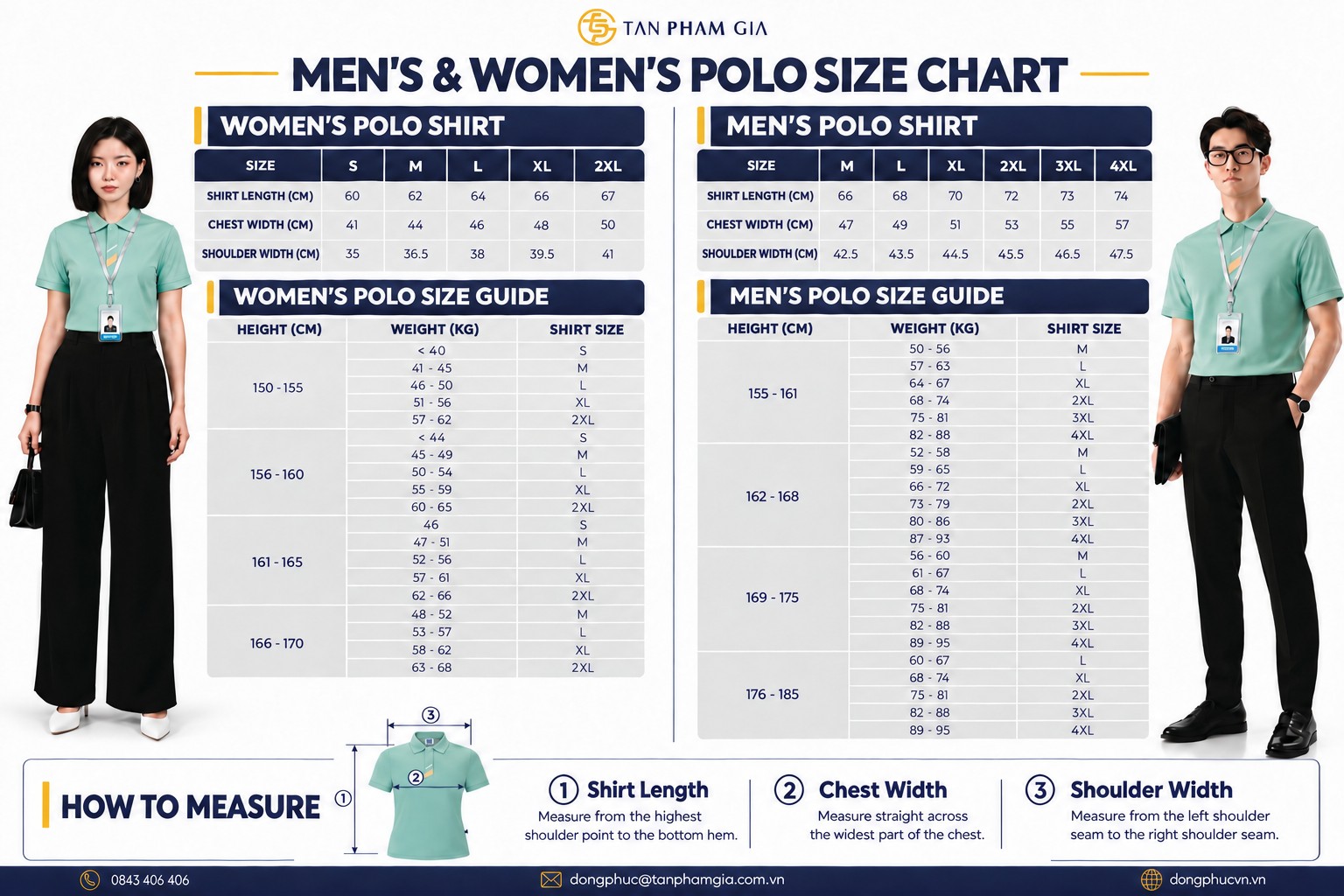
Selecting the correct uniform polo shirt size helps employees feel comfortable while maintaining a consistent professional image across the organization. Even a well-designed polo shirt may be impractical if it is too loose, too tight, or poorly proportioned for the wearer. Sizing issues can also lead to repeated adjustments during uniform distribution.
For companies with large workforces, size selection involves more than sending employees a reference chart and asking them to register. Differences in body proportions, men’s and women’s fits, preferred ease, job requirements, and data collection across departments can all affect the final result. Without one approved sizing reference, businesses may encounter incorrect registrations, missing sizes, duplicate records, or last-minute changes before production.
This guide provides men’s and women’s uniform polo shirt size charts based on the sizing system used by Tan Pham Gia Uniform. It also explains how to read garment measurements, select sizes, collect employee data, and control sizing discrepancies before bulk production.
Uniform Polo Shirt Size Chart for Asian Fits
A size chart provides an initial reference for matching an employee’s build with the dimensions of a finished garment. However, the same size label may represent different measurements when the garment fit, fabric, or construction specifications change. Businesses should therefore use the size chart created for the exact polo shirt being ordered rather than substitute measurements from another product.
The charts below show the men’s and women’s polo shirt measurements currently applied by Tan Pham Gia Uniform for Asian-fit garments. All garment measurements are in centimeters. The height-and-weight charts are sizing recommendations only; they do not replace garment measurements or sample fitting for employees with atypical proportions or special fit requirements.
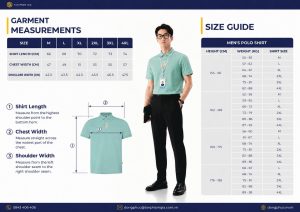
Men’s Uniform Polo Shirt Size Chart
For a more accurate comparison, select a polo shirt that already fits well, lay it flat, and measure it using the method described later in this guide. If the wearer’s chest, shoulders, waist, or abdomen differs substantially from the average proportions associated with a height-and-weight range, prioritize actual garment measurements and the ease required for movement rather than weight alone.
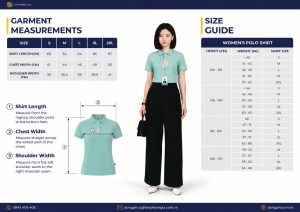
Women’s Uniform Polo Shirt Size Chart
The following values are retained from the official recommendation chart. If an employee falls within a gap between the listed ranges, is outside the height or weight range, or has distinctive body proportions, the business should not estimate a size without verification. The safer approach is to compare finished-garment measurements, arrange a sample fitting, or consult the manufacturer before confirming the order.
Measurements Used in a Uniform Polo Shirt Size Chart
A common sizing mistake is confusing body measurements with finished-garment measurements. For example, a men’s chest width of 47 cm refers to the width of the shirt when laid flat, not the wearer’s chest circumference. Doubling the chest width provides an approximate garment circumference, but fabric stretch, garment construction, and the ease needed for movement must still be considered.
The three measurements in the charts are defined as follows:
- Shirt length: Measure from the highest shoulder point to the bottom hem.
- Chest width: Measure straight across the widest part of the chest while the shirt is laid flat.
- Shoulder width: Measure from the left shoulder seam to the right shoulder seam.
When measuring a sample shirt, position the collar correctly and smooth the body without stretching the fabric. Use a flexible measuring tape and measure along a straight line. Every sample should be measured using the same method to prevent discrepancies between departments, branches, or individual employees.
Fit is also affected by garment design and material characteristics. The same employee may need different sizes in a closer-fitting and a relaxed-fit polo, or in fabrics with different levels of stretch. A uniform polo shirt size chart should therefore always be used with the approved garment sample, fabric, and technical specifications for the order.
Criteria for Selecting the Right Polo Shirt Size for Employees
A size chart is a reference rather than a guarantee of fit. Before distributing a registration form, the business should define the garment fit, preferred ease, and approved sample employees will use for comparison.
Distinguish Between Men’s, Women’s, and Unisex Fits
Men’s, women’s, and unisex styles have different garment structures and measurement systems. The same M label may correspond to different shirt lengths, chest widths, and shoulder widths, so sizes should not be converted directly between fits.
The registration form should require employees to select the garment style or fit before selecting a size. If the uniform program includes several designs, each garment should have its own item code.
Consider Body Proportions and Preferred Ease
Two employees with the same height and weight may have different shoulder, chest, waist, abdomen, or torso proportions. Employees should compare the recommendation chart with a well-fitting shirt and consider how much room they prefer.
Employees who fall between sizes, have atypical proportions, or require more room for movement should try on a sample or receive individual sizing guidance.
Approve One Measurement Chart and Reference Sample
Each uniform design should have one approved size-chart version showing the applicable item code, fit, fabric, and approval date. A dress shirt, crew-neck T-shirt, or different polo shirt should not be used as a sizing reference unless its measurements have been confirmed as compatible.
For programs covering several branches, every location should use the same controlled document to prevent employees from referring to outdated or incorrect charts.
Does your business need help selecting the right uniform polo shirt size chart for its workforce? Contact Tan Pham Gia Uniform via Zalo or submit a request form to discuss garment fit, measurements, and sample-based size verification.
How to Collect and Consolidate Employee Polo Shirt Sizes
Once the sizing reference has been approved, the business must convert each employee’s selection into data that can be reviewed and used for production.
Create an Employee Size Registration Form
A shared form for departments and branches should include:
- Employee number or another unique identifier;
- Full name;
- Department, business unit, or work location;
- Garment item code and fit;
- Selected size;
- Number of shirts;
- Sample-fitting or confirmation status;
- Notes for cases requiring individual review.
Use predefined selections for departments, garment items, fits, and sizes rather than unrestricted text fields. The business should also specify the registration deadline, the form-lock date, and the contact responsible for handling changes.
Consolidate Quantities by Department and Distribution Location
Classify the data by garment item, fit, size, quantity, department, and distribution location. Each branch should assign a coordinator to review its records before submitting them to the central team.
Rows with missing information, duplicate employee numbers, or sizes outside the approved chart should be separated for verification rather than automatically included in production quantities.
Review and Approve the Final Size List
Before approval, check that every row is complete, reconcile the total quantity by size with total demand, and verify unusual selections. If an employee will receive several garment styles, confirm the size for each fit separately.
The final list should include an “approved” status and a cutoff date. Any later change must be submitted through the designated coordinator.
How to Reduce Sizing Errors in Bulk Polo Shirt Production
Sizing errors may lead to exchanges, shortages or surpluses in specific sizes, and delays in the distribution plan. Businesses should control their data before production rather than waiting until the order is delivered.
Check Registration Data for Accuracy
Filter records with blank fields, duplicate employee numbers, incorrect size systems, or missing confirmation. Choices that differ significantly from reference data should be checked with the employee, but the coordinator should not change a size without approval.
All corrections must be recorded in one centralized list. Avoid maintaining several parallel versions of the same data.
Arrange Sample Fittings and Record Feedback When Needed
Sample fittings are particularly useful for employees who fall between sizes, are outside the listed range, have atypical proportions, or perform jobs requiring substantial movement.
The fitting sample must match the approved fit, measurements, and fabric. Enter each result directly into the shared list with a confirmation status instead of relying on verbal feedback or private messages.
Establish Final Approval Before Bulk Production
The approved production file should clearly identify the garment item, fit, fabric, measurement chart, and quantity for each size. Before approval, compare three totals: the total number of shirts in the employee list, the sum of all size quantities, and the total order quantity.
If the three figures do not match, identify and resolve the discrepancy before releasing the order to production. The buyer and manufacturer should also agree on who has approval authority and how changes submitted after the cutoff will be handled.
Managing Size Data for Distribution and Reorders
Size data should remain available after production so the business can manage distribution, exchanges, new employees, and future uniform reorders.
Store the Approved Size List for Each Rollout
For each rollout, retain the final employee list together with the garment item code, fit, measurement chart, and approval date. Clearly distinguish the original registration data from the final approved version.
Editing rights should be limited to designated coordinators. Establish clear file-naming and version-control conventions to reduce the risk of using the wrong document.
Track Distribution Status and Exceptions
During distribution, record whether each employee has received the uniform and note any exchange, shortage, or additional requirement. After distribution, summarize the number of size exchanges and their causes.
If many employees select the wrong size for the same garment, revise the sizing instructions or arrange earlier sample fittings for the next rollout.
Standardize Data for Future Uniform Reorders
Previous size data should be treated as a reference only. Before reordering, confirm that the garment design, fit, fabric, and measurements remain compatible, and review current employee records and quantities.
If garment specifications have changed, employees should select their sizes again. Even when the same item is retained, update the records of employees who previously exchanged sizes.
Tan Pham Gia Uniform’s Corporate Polo Shirt Sizing Support
For uniform programs covering large workforces or several user groups, sizing should be considered together with garment design, fit, fabric, and distribution planning. Tan Pham Gia Uniform works with businesses to identify the information needed to support size selection and approval before production.
Fit and Measurement Guidance Based on Business Requirements
The buyer should provide information about employee groups, working environments, garment design, and preferred ease. The size chart can then be matched with the correct sample and technical specifications.
Employees who fall between sizes, are outside the reference range, or need additional ease should be identified early for sample fitting or individual review.
Confirming Uniform Requirements Before Bulk Production
Before production, both parties should confirm quantities, employee groups, garment items, fits, and the rollout plan. The measurement chart and size list must belong to the same approved version.
Cases requiring individual confirmation should be resolved before the cutoff date, particularly when data is collected from multiple departments or locations.

Preparing a uniform program for several departments or branches? Send Tan Pham Gia Uniform information about employee quantities, user groups, and design requirements to discuss an implementation plan suited to your business.
Frequently Asked Questions About Corporate Polo Shirt Sizes
Questions 1. Is Selecting a Polo Shirt Size by Height and Weight Accurate?
Height and weight provide only an initial reference. Size also depends on body proportions, garment fit, finished measurements, fabric, and preferred ease. Employees who fall between sizes or have atypical proportions should compare the chart with a well-fitting shirt or try on a sample.
Questions 2. What Should a Business Do When an Employee Changes Their Size After Registering?
The request should be sent to the designated coordinator, verified, and updated in the centralized data source. If the list has not been finalized, the manager can approve a new version. If production has already started, the business should confirm whether an adjustment is feasible with the manufacturer before responding to the employee.
Questions 3. How Should a Company With Several Branches Manage Employee Polo Shirt Sizes?
Use one standardized registration form, one centralized data source, and one coordinator at each branch. Local coordinators should review employee information before the central team consolidates it using the same item codes, fits, and size system. This approach prevents locations from using inconsistent charts or naming conventions.
Questions 4. Can a Business Reuse the Size Chart From a Previous Uniform Order?
Previous data may be used as a reference if the garment design, fit, fabric, and measurements remain compatible. However, the business should still review its current workforce, previous size exchanges, and actual requirements. If garment specifications have changed, verify sizes again instead of copying the old list without review.
Confirm Sizes Before Starting Bulk Uniform Production
A uniform polo shirt size chart is effective only when it is used with the correct garment design, fit, and measuring method. For a large workforce, the business needs one standardized registration form, one centralized data source, and a final approval stage before production. Well-managed sizing data also supports smoother distribution and future reorders.
Need help confirming your uniform polo shirt size chart before bulk production? Contact Tan Pham Gia Uniform to discuss the approved sample, technical measurements, and rollout plan for your workforce.