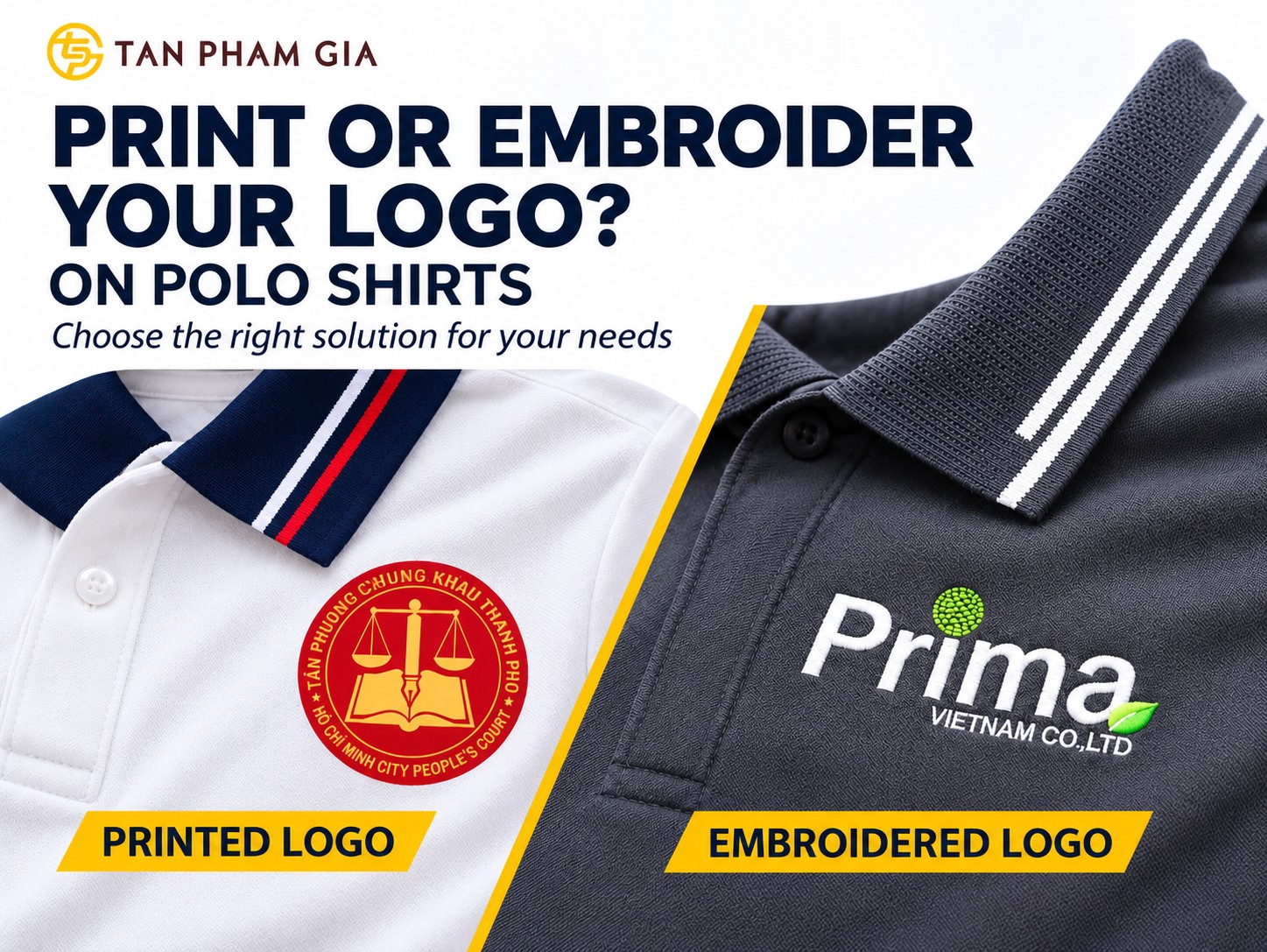
Whether to print or embroider a logo on corporate polo uniforms is a common question for HR, administration, and procurement teams preparing a large uniform order. Each method suits different logo designs, fabrics, and usage goals, so there is no single answer for every situation.
In this guide, Tan Pham Gia Uniform compares printing and embroidery, explains the key criteria businesses should consider, and outlines a practical sampling process. This helps businesses choose a logo application method that looks professional and remains suitable throughout the garment’s service life.
Is the Design File Enough to Choose a Logo Application Method?
No. The design file alone is not enough to finalize printing or embroidery. It shows how the logo looks on a screen, but not how it will appear on the actual fabric.
The final result depends on three factors: fabric, application technique, and the wearer’s experience. The same logo can create different visual effects and levels of stability on a structured piqué knit compared with a lightweight fabric.
For this reason, businesses should test the logo on the actual fabric planned for production before approving the final method. This step helps identify issues with detail, color, and hand feel before the full batch is produced.

Key Stages in Applying a Logo to Corporate Polo Shirts
The logo application process for corporate polo shirts generally includes five consecutive stages:
- Receive and review the design file: Check the file format, resolution, number of colors, and logo complexity.
- Recommend a suitable method: Propose printing, embroidery, or a combination of both based on the logo and fabric characteristics.
- Create and adjust a sample: Apply the logo to the actual fabric and refine its size, placement, and color.
- Approve the final sample: The business confirms the approved sample as the standard for the entire order.
- Produce in bulk and conduct quality control: Compare finished garments with the approved sample.
Within the uniform-ordering process, these stages are part of design development, sample approval, production, and quality control. Skipping any stage-especially sample testing-is a common reason finished garments fail to meet initial expectations.
Already have a logo file? Send it to Tan Pham Gia Uniform for a review of its size, colors, detail level, and suitability for the selected polo fabric. The team can then recommend a printing or embroidery method before the product specifications are finalized.
A Logo That Looks Good in the Design May Not Look the Same on a Corporate Polo Shirt
The more detailed the logo, the more carefully it should be tested before production. A design displayed on a screen is not limited by fabric fibers, thread density, or ink absorption. A finished polo shirt is.
Detailed Logos Are More Difficult to Apply
Small lines, thin lettering, or multiple layers of detail can lose clarity when the wrong technique is used. With embroidery, small details may merge because of thread thickness. With printing, lines that are too thin may blur or break if ink does not distribute evenly across the fabric surface.
Complex logos should therefore be reviewed from a technical perspective at the beginning rather than having a method chosen first and the design adjusted later.
Logo Size Directly Affects the Final Quality
A logo that is too small may be difficult to read, while one that is too large can look heavy, stiff, or unbalanced on the chest. The appropriate size should be considered together with the placement, collar style, and overall proportions of the polo shirt.
A physical sample allows the business to evaluate these proportions on the actual garment instead of estimating them from a design file.
Logo Colors Should Be Checked on the Actual Fabric
Colors displayed on a screen often differ from the result on fabric. The difference depends on the shirt color, fabric type, printing ink, and embroidery thread.
For businesses with strict brand-identity standards, it is best to provide the official brand color codes and compare the sample under practical lighting conditions. This helps keep the logo color on the shirt aligned with the brand’s visual direction.
The Approved Design Is the Reference for the Finished Product
All adjustments made during production should be based on the design agreed upon by both parties. If the size, placement, or color changes, the adjustment should be recorded in writing or reflected in an updated approved sample.
This creates a clear reference for quality acceptance and helps limit inconsistencies.
The Difference Between Printing and Embroidering a Logo on Corporate Polo Shirts
Printing and embroidery create logos on fabric in different ways. As a result, they differ in durability, hand feel, ability to reproduce detail, cost, and production time.
Embroidery uses thread to build a raised logo on the fabric surface, while printing applies ink to the surface or into the fabric structure.
This table is general guidance. Actual cost and production time depend on the logo, order quantity, and fabric. Contact Tan Pham Gia Uniform for advice based on the specific order.
Advantages and Limitations of Each Method:
- Logo embroidery: Durable and structured, with a professional, premium feel. The limitations are reduced clarity for very small details, gradients, or multiple colors, while cost may increase with logo complexity.
- Logo printing: Well suited to multicolor graphics and fine lines, and often practical for large orders. Its durability and hand feel depend heavily on the printing method and fabric.
Not sure whether your logo is better suited to printing or embroidery? Speak with a Tan Pham Gia Uniform consultant via Zalo for a preliminary review of the logo size, colors, detail level, and expected appearance on a polo shirt before sampling.
When Should a Business Choose Embroidery for Corporate Polo Shirts?
Embroidery is suitable when the logo is relatively simple and the business prioritizes durability and a polished appearance. Consider embroidery when:
- The logo has limited detail and lines that are thick enough to reproduce with thread.
- The garments need to withstand frequent use and washing over an extended period.
- The business wants a premium, structured look, such as for executive or office polo shirts.
- The order quantity is moderate and the logo does not require highly complex color reproduction.
Embroidery is often selected for fabrics with a more substantial surface and good shape retention. One example is the TPG Signature™ line with Soft Pique™ fabric, made from 60% cotton and 40% polyester at 210 GSM, which is positioned for executive and Corporate Premium uniforms.
However, the final method should still be confirmed with a sample made on the actual fabric.
When Should a Business Choose Printing for Corporate Polo Shirts?
Printing is suitable when the logo contains many details or colors, or when the order needs to balance cost and production time. Consider printing when:
- The logo includes multiple details, multiple colors, or gradient effects.
- A large quantity is required at a practical cost, such as uniforms for a retail chain or factory.
- A shorter production timeline is preferred.
- The logo contains imagery or fine lines that would be difficult to reproduce through embroidery.
For polo shirts used frequently in operational environments, businesses can combine printing with a durable fabric such as Royal Pique™ from the TPG Prime™ line. This fabric is 100% polyester, 270 GSM, and is commonly used for factories, logistics, F&B, and retail chains.
The appropriate printing technique should be reviewed for each fabric during the sample-development stage.

Can Printing and Embroidery Be Combined on the Same Corporate Polo Shirt?
Yes. The two methods can be combined on one corporate polo shirt. This allows the business to use the strengths of each technique instead of forcing the entire logo to follow a single method.
Benefits of Combining Both Methods:
- Retain the structured, premium feel of embroidery in a prominent area.
- Reproduce complex details or colors in areas better suited to printing.
Situations Where a Combination May Work Well:
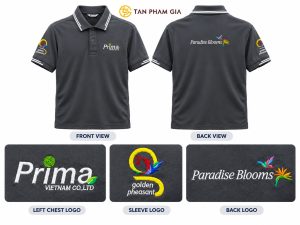
- Embroider the main logo on the chest and print supporting information, such as a department name or slogan, on the sleeve or back.
- Alternatively, print a multicolor graphic and embroider simple lettering or an icon to create a raised accent.
Technical and Cost Considerations:
Combining two methods usually requires additional production stages and precise alignment between the different elements. As a result, cost and production time may differ from using a single method.
Businesses should discuss the approach early so the final solution fits the budget and timeline.
Finished Corporate Polo Shirts Should Match the Approved Sample
The approved sample is the reference standard for the entire order. Before bulk production begins, the business should confirm the logo placement, size, color, sharpness, and hand feel.
Ways to Maintain Consistency Across Finished Products:
- Compare finished garments with the approved sample using the agreed criteria.
- Check logo placement, size, and color at each production stage.
- Conduct multiple levels of quality control before delivery, especially for large orders.
Risks of Skipping Sample Comparison: The logo may be misplaced, colors may vary between batches, or the finished product may feel different from the initial expectation. For a business with hundreds of employees, small inconsistencies repeated across many garments can affect uniformity and brand presentation.
Customers Wear the Actual Shirt, Not the Design File
The real experience of wearing a finished garment matters more than an image on a computer screen. Employees may wear corporate polo shirts for many hours each day, while customers see the logo in real-world interactions.
Businesses should prioritize three factors: how the shirt feels when worn, how the logo and fabric perform after repeated washing, and how the brand appears on the actual garment. Excessively dense embroidery may feel stiff on the chest, while an oversized printed logo may reduce comfort in the decorated area.
The design file is a supporting tool, not the final product. A physical sample and feedback from actual wearers provide a more reliable basis for decision-making.
Tan Pham Gia Uniform Helps Businesses Choose the Right Logo Application Method
Tan Pham Gia Uniform provides corporate uniform solutions for B2B customers and large-volume orders. When businesses are deciding whether to print or embroider a logo, Tan Pham Gia Uniform supports the process from needs consultation and fabric selection through design, sample approval, production, quality control, and delivery.
Specifically, Tan Pham Gia Uniform supports businesses with:
- Recommendations based on logo characteristics, fabric type, and actual usage requirements.
- Physical samples and adjustments in consultation with the business until the result matches the intended brand direction.
- Multiple quality-control stages to keep finished products aligned with the approved sample, including for large orders.
Preparing to order corporate polo shirts? Submit a request through the contact form or contact the hotline/Zalo number at +84 843 406 406 for advice on logo application and a quotation based on your actual requirements.
Conclusion
There is no single best method for every business. Embroidery emphasizes durability and a structured, polished appearance. Printing is stronger for detailed graphics and large-volume efficiency. Combining both methods can balance these advantages.
The most important steps are testing the logo on the actual fabric and approving a physical sample before bulk production. When deciding whether to print or embroider a logo on corporate polo uniforms, businesses should start with the logo design, fabric characteristics, and long-term usage requirements.
Frequently Asked Questions About Printing and Embroidering Logos on Corporate Polo Shirts
Questions 1. Should a multicolor logo be printed or embroidered?
Printing is generally the better choice. Multicolor logos and gradients are difficult to reproduce accurately with embroidery thread. If the business wants an embroidered accent, both methods can be combined. The final choice should be confirmed through a physical sample.
Questions 2. Which method is more durable for polo shirts worn every day?
Embroidery is often preferred when high durability is required for a simple logo. However, durability also depends on the fabric, application technique, and washing method. For complex logos, a suitable printing technique can still meet everyday-use requirements.
Questions 3. How different are the costs of printing and embroidery?
Cost depends on the logo’s complexity, size, number of colors, and order quantity. For large orders, printing is often more cost-efficient, while embroidery may cost more when the logo contains many details. Contact Tan Pham Gia Uniform for advice based on your specific requirements.
Questions 4. Can a complex logo be embroidered?
It may be possible, but the logo should be evaluated first. Logos with very fine lines or many details may need to be simplified or resized to remain clear when embroidered. A physical sample helps determine whether the logo is suitable for embroidery or should be printed instead.
Questions 5. How long does each method take?
Production time depends on the order quantity, logo complexity, and sample-approval process. In general, printing is often faster for large orders, while embroidery can take longer when the logo contains many details. Tan Pham Gia Uniform will confirm the expected timeline after reviewing the request.
Questions 6. When should printing and embroidery be combined?
A combination works well when the logo includes an element that needs a raised, structured appearance and another element with multiple colors or fine details. For example, the main chest logo can be embroidered while supporting information is printed on the sleeve or back.
This approach requires accurate technical alignment and should be reviewed during the consultation stage.