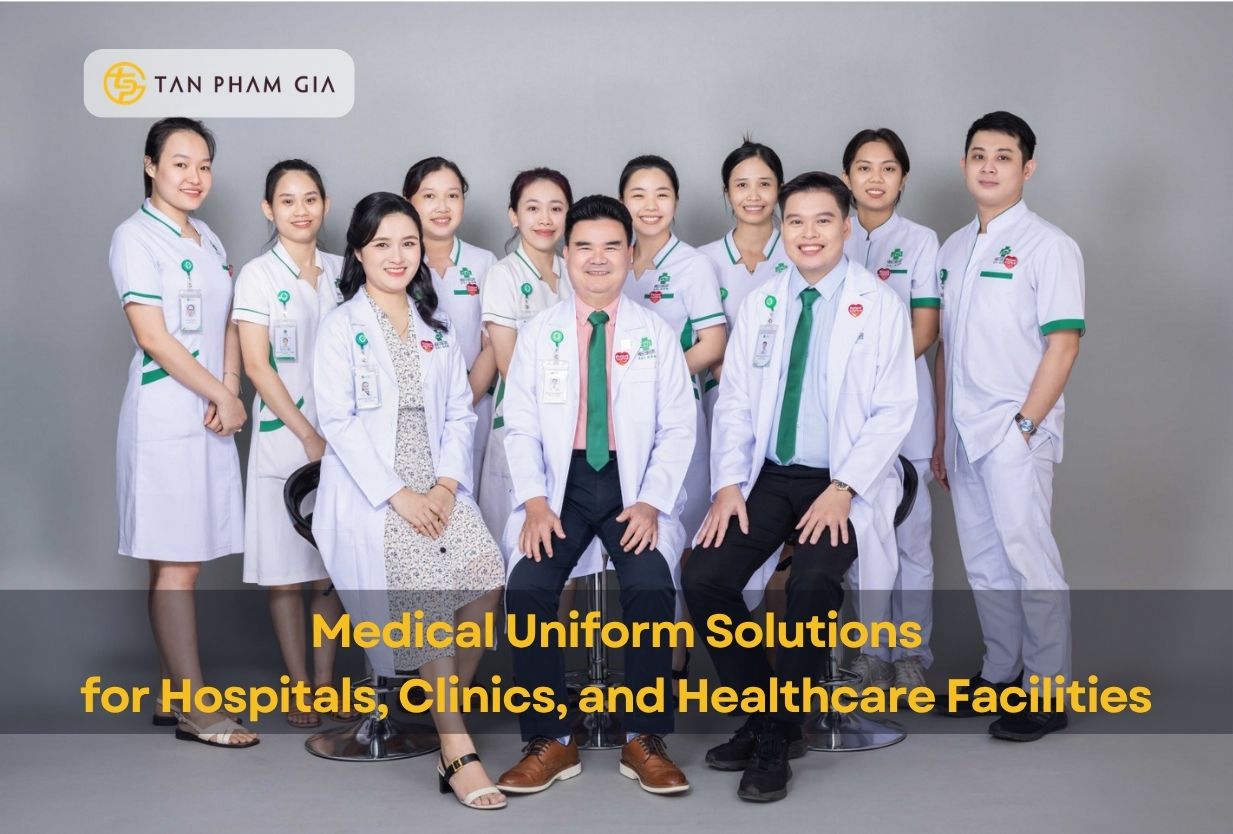
Medical uniforms for hospitals, clinics, and healthcare facilities need to be selected based on multiple factors, including job role, working environment, professional requirements, wearer comfort, brand identity, and consistency across large-scale uniform programs.
For hospitals and healthcare systems with multiple employee groups, standardizing uniform styles, colors, fabrics, sizing, and technical specifications from the beginning can help minimize inconsistencies between departments and future reorder batches.
Tan Pham Gia Uniform provides custom uniform design and manufacturing solutions for businesses, hospitals, clinics, and healthcare systems requiring uniforms tailored to different employee groups.
What Requirements Should Medical Uniforms Meet?
Medical uniforms need to balance job-specific requirements, ease of movement, fabric performance, professional identification, and consistency across the facility. For healthcare facilities within the applicable scope of medical uniform regulations, designs should also be reviewed against current requirements before production.
Medical Uniforms Should Match Each Job Role
Different positions in a healthcare facility involve different tasks and working conditions. Doctors, nurses, technicians, surgical staff, and reception personnel do not necessarily require the same uniform style.
When developing a uniform program, businesses should first identify each job group and then define the appropriate garment style, colors, accessories, identification elements, and functional requirements.
Early segmentation also makes it easier to manage quantities, size breakdowns, and uniform allocation when implementing large-scale orders.
Fabrics Should Support Comfort and Hygiene Requirements
Medical uniform fabrics should be selected based on wearing frequency, level of physical activity, working conditions, and hygiene requirements for each role.
Key considerations may include:
- Soft hand feel and skin comfort
- Moisture absorption or moisture management
- Wrinkle resistance after washing
- Shape retention after repeated use
- Ease of washing, ironing, and maintenance
- Suitability for the local climate and working environment
Fabric should not be selected based solely on fiber composition or unit cost. The same fiber composition can produce different wearing experiences depending on the weave, fabric weight, construction, and finishing.
Design and Colors Should Support Role Identification
Colors and garment designs can help distinguish job functions, departments, or professional roles.
For healthcare facilities with multiple departments, businesses should develop a consistent visual system rather than selecting unrelated colors for individual uniform styles. Logos, name badges, primary brand colors, and other identification elements should be incorporated into the overall uniform design.
Uniforms Should Remain Consistent Across the Facility
For hospitals, clinics, and healthcare networks, consistency goes beyond using the same color.
Businesses should standardize:
- Color codes
- Garment styles
- Fabrics
- Size charts
- Technical specifications
- Logo placement
- Name badge placement
- Sewing specifications
- Approved reference samples for future production
Note: Vietnam’s Circular 45/2015/TT-BYT sets out requirements concerning medical uniforms, including general criteria related to safety, ease of movement, fabric, design, color, and identification of different groups. Healthcare organizations should verify the current applicable regulations when developing medical uniform specifications.
>>> Learn more: Corporate Uniform Solutions for Healthcare, Spa & Service
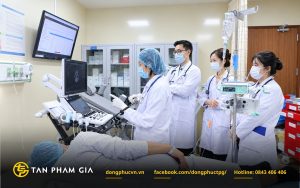
Medical Uniform Solutions for Different Healthcare Facilities
Healthcare facilities vary significantly in workforce size, organizational structure, and service scope. Uniform programs should therefore be developed according to the characteristics of each facility type.
Hospital Uniforms for Large Healthcare Facilities
Hospitals typically employ multiple groups, including doctors, nurses, technicians, pharmacists, and administrative personnel. Uniform programs therefore need to account for clear role differentiation and consistency across production batches.
- Develop different uniform styles for multiple job roles within one project
- Support large-volume production with stable manufacturing capacity
- Maintain consistency across departments and clinical areas
- Facilitate reorders for new employees or uniform replacement
- Standardize colors, sizes, and garment specifications across production batches

Uniforms for General and Specialty Clinics
Clinics typically have smaller workforces than hospitals but may still require different uniform styles for specific specialties.
- General clinics: Flexible uniform solutions for consultation, examination, and administrative roles
- Dental clinics: Fabrics that are easy to maintain and suitable for repeated patient-facing activities
- Pediatric clinics: Softer colors and approachable designs may help create a more welcoming environment for children
- Other specialty clinics: Uniform specifications can be adjusted according to the clinical environment and job requirements

Uniforms for Healthcare and Medical Spa Facilities
Healthcare facilities, medical spas, or aesthetic clinics that do not perform medical examination and treatment within the scope covered by Circular 45/2015/TT-BYT may not be subject to the same uniform requirements. These businesses can instead develop uniforms according to their service model, brand identity, and customer experience.
For these models, uniforms often place greater emphasis on brand presentation, visual consistency, and customer-facing experience than on the regulatory framework applicable to medical examination and treatment facilities.
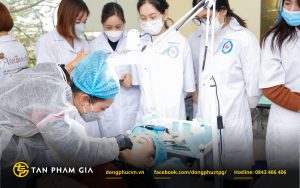
Uniforms for Pharmacy Chains and Pharmaceutical Retail Systems
For pharmacy chains with multiple locations, uniforms should prioritize consistent brand identification across branches and efficient reordering when new stores open or employees join the organization. The objective is not simply to produce uniforms once, but to establish a standardized uniform system that can be maintained as the network expands.

If your organization is developing uniforms for multiple job roles or healthcare locations, Tan Pham Gia can advise on uniform segmentation, fabrics, and production specifications based on your actual workforce and project requirements.
Medical Uniforms by Job Role
Segmenting uniforms by job role allows businesses to define appropriate garment styles, colors, fabrics, and identification requirements for each employee group.
Doctor and Medical Specialist Uniforms
Doctor uniforms need to present a professional clinical image while allowing convenient movement and clear identification of the wearer’s role.
When developing hospital doctor uniforms, businesses should consider:
- Applicable clinical coat or medical uniform requirements
- Color
- Garment length and construction
- Number and placement of pockets
- Name badge placement
- Trouser specifications
- Caps or other accessories where required
Where the healthcare facility uses its own brand identity, logos and other visual elements should be incorporated into a design that has been reviewed before bulk production.

Nurse, Midwife, and Medical Assistant Uniforms
Nurses, midwives, and medical assistants typically move and perform tasks frequently throughout their shifts. Uniform design therefore needs to balance professional identification, mobility, and long-wear comfort.
Businesses should carefully evaluate:
- Shoulder and armhole dimensions
- Arm mobility
- Garment length
- Pocket placement
- Stretch performance where spandex-containing fabrics are used
- Shape retention after repeated washing

Uniforms for Technicians and Clinical Specialists
Technicians may work in laboratories, diagnostic imaging departments, or other specialized clinical areas.
Uniform specifications should be developed according to the actual working environment rather than applying one standard design to every technical role. Key considerations include physical activity, wearing duration, hygiene requirements, and professional tasks.
Uniforms for Surgical, Anesthesia, Recovery, and Sterilization Areas
These areas require separate consideration because of their specific working conditions and hygiene requirements.
Before developing uniforms for these departments, businesses should define:
- Area of use
- Required garment type
- Changing and laundering procedures
- Fabric requirements
- Department identification colors
- Required accessories
Standard medical uniforms should not simply be modified for specialized clinical areas without first establishing the facility’s specific requirements.

Pharmacist Uniforms
Pharmacist uniforms can be developed according to the working environment and brand identity of a hospital, pharmacy, or pharmaceutical retail system.
For multi-location pharmacy chains, businesses should standardize colors, garment fit, logos, name badges, and sizing to maintain a consistent brand image across locations.

Uniforms for Reception, Administration, and Cashier Staff
Reception and other customer-facing employees need uniforms that clearly communicate their role while remaining appropriate for a healthcare service environment.
Common considerations include:
- Polished and professional styling
- Brand colors
- Long-wear comfort
- Easy coordination with accessories
- Logo and name badge placement
- Reorderability when new employees join
Uniforms for Support and Other Healthcare Staff
Cleaning personnel, patient transport teams, maintenance staff, security personnel, and other support roles may require separate uniform specifications based on their working environments.
For employees who move frequently or perform physically demanding tasks, businesses should prioritize functional designs and fabrics suited to the intensity of use.
Medical Uniform Regulations Under Circular 45/2015/TT-BYT
Circular 45/2015/TT-BYT, issued by Vietnam’s Ministry of Health on November 30, 2015 and effective from February 1, 2016, provides requirements concerning the color, fabric, and design of medical uniforms for applicable healthcare settings in Vietnam.
Who Is Covered by Circular 45/2015/TT-BYT?
The Circular applies to public and private medical examination and treatment facilities and covers various groups involved in healthcare activities, including medical practitioners and certain employees, trainees, students, interns, patients, mothers after childbirth, patients’ family members, visitors, and other groups within its defined scope.
Other healthcare facilities may also refer to the Circular when selecting uniforms based on their operating conditions, job characteristics, and professional requirements.
Organizations should review the current legal framework to determine which requirements apply to their specific facility and employee groups.
Medical Uniform Colors and Design Requirements
The Circular specifies colors and design characteristics for different groups and uniform categories.
Therefore, when developing hospital doctor uniforms or uniforms for other healthcare groups, businesses should not rely solely on market examples. The applicable requirements for each employee group should be reviewed before production.
Medical Uniform Fabric Requirements
The Circular sets out general fabric criteria including low wrinkling, softness, ease of washing and ironing, ease of disinfection, moisture absorption, and suitability for the local climate.
This highlights why fabric selection should not be based solely on fiber composition. Businesses should also consider fabric weight, construction, working environment, laundering methods, and frequency of use.
Name Badges and Professional Identification
Name badges form part of medical uniforms under the applicable requirements. Their placement and presentation should follow the requirements for the relevant uniform category.
For large-scale uniform programs, standardizing name badges, logos, and identification elements during the design stage can help reduce production errors.
Uniforms for Surgical Areas
Uniforms used in specialized clinical areas such as surgery should be assessed separately according to the facility’s operational requirements and applicable regulations.
Businesses should not use a standard medical coat as a substitute for specialized surgical-area garments without first determining the facility’s requirements for clothing, changing procedures, laundering, and hygiene control.
What Should Businesses Consider When Developing Medical Uniforms?
Before production, businesses should:
- Identify the applicable facility and employee groups.
- Segment uniforms by professional role.
- Review applicable color and design requirements.
- Select fabrics according to actual use.
- Standardize name badges and brand identification.
- Approve physical samples before bulk production.
- Record technical specifications and approved samples for future reorders.
- Verify the current applicable regulations at the time of implementation.
Note: The legal information in this section is provided for general reference. Hospitals and clinics should verify the current applicable regulations and internal requirements before finalizing uniform specifications.
>>> Learn more: Corporate Uniform Consultation & Design | Tan Pham Gia

Which Fabrics Are Suitable for Medical Uniforms?
There is no single fabric suitable for every medical role. Fabric selection should take into account the working environment, wearing duration, level of physical activity, hygiene requirements, laundering conditions, and desired garment performance.
>>> Learn more: Fabric Collection – Corporate Uniform Materials | Tan Pham Gia
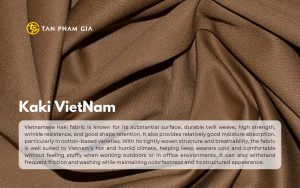
Vietnamese Kaki – Which Uniform Groups Can Use It?
Vietnam-made Kaki can be considered for uniforms requiring a relatively structured appearance and stable garment shape.
In actual production, the specific Kaki fabric, construction, weight, and finishing should be evaluated before determining whether it is suitable for a particular employee group.
Note: The “Vietnamese Kaki” referenced in the case study below is a specific fabric supplied for that project. It should not be interpreted as a description of all Kaki fabrics made in Vietnam.
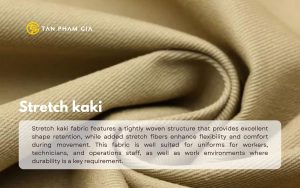
Stretch Kaki – When Is Stretch Performance Useful?
Stretch Kaki can be considered for employees who require greater mobility than roles involving mostly stationary work.
The exact fiber composition and stretch ratio should be confirmed based on the selected fabric. Different stretch Kaki fabrics can vary significantly in flexibility, breathability, durability, and shape retention.
Cotton and Moisture-Absorbing Fabrics
Cotton is often considered for healthcare environments where a natural hand feel and moisture absorption are priorities.
However, for large-scale uniform programs, businesses should also assess shrinkage, wrinkling, colorfastness, and shape retention after actual laundering.
For healthcare systems requiring high consistency, physical sample testing before bulk production can help identify potential differences between expected and actual garment performance.
Fabric Selection Criteria by Working Environment
If your organization has not yet determined the most suitable fabric for each employee group, Tan Pham Gia can provide fabric recommendations based on actual job functions and working conditions.
5 Key Factors to Consider Before Ordering Medical Uniforms
Before placing a large medical uniform order, healthcare organizations should establish five key areas of information to reduce inconsistencies between production batches.
Define Employee Groups and Required Quantities
Prepare a list of professional roles such as doctors, nurses, technicians, pharmacists, and administrative staff, together with the required quantity for each group.
This helps reduce shortages or excess quantities during uniform distribution.
Define Garment Styles and Brand Identification Requirements
Establish garment styles according to each professional role, applicable requirements, and the level of brand visibility the healthcare facility wants to incorporate into its uniforms.
Select Fabrics Based on the Working Environment
Use the fabric criteria above together with the actual working conditions of each employee group rather than applying one fabric across the entire uniform program.
Standardize Sizes, Colors, and Product Specifications
Record the approved size chart, color codes, and technical specifications from the first production order so that future reorders can follow the same standards.
Approve Physical Samples Before Bulk Production
Always review physical samples for fit, fabric, actual color, and construction before mass production, particularly when the project involves multiple professional groups.
If your organization has not yet determined the appropriate uniform style, fabric, or production specifications for each employee group, contact Tan Pham Gia via Hotline / Zalo: 0843 406 406 for recommendations based on your actual requirements and order quantity.
Common Mistakes When Ordering Medical Uniforms
Medical uniform problems are not always caused by fabric selection. Many issues originate from insufficient standardization during the initial planning stage.
Using One Uniform Style for Different Professional Roles
Doctors, nurses, technicians, reception staff, and support personnel may have different working requirements.
Using one uniform design across all groups can make the garment less suitable for certain roles and make professional identification more difficult.
Choosing Fabric Based Only on Unit Cost
Price is one factor in procurement, but it should not be the only consideration.
Businesses should also evaluate service life, washing frequency, wearer comfort, shape retention, shrinkage, and hygiene requirements.
Failing to Standardize the Size Chart Before Production
Without a standardized size chart, the same size code can result in different actual garment dimensions.
For large orders, businesses should approve the size chart and garment measurements before bulk cutting and sewing.
Skipping Physical Sample Approval
Without a physical sample, it is difficult to accurately evaluate garment fit, color, logo placement, and sewing specifications.
The approved sample should be retained as a reference throughout production.
Failing to Keep Approved Specifications for Reorders
This can become a recurring issue for hospitals, clinics, and healthcare networks with ongoing recruitment.
Without an approved sample and technical specifications, each reorder may result in differences in color, fit, or garment details.
Failing to Control Colors and Brand Identification Across Production Batches
For multi-location healthcare systems, differences in fabric color or logo placement can affect overall brand consistency.
Businesses should establish color codes, approved samples, and technical specifications from the first order.

Custom Medical Uniform Manufacturing Process for Businesses
A custom medical uniform project typically involves six stages, from requirements gathering through final delivery.
- Step 1. Requirements and Role Segmentation: Gather workforce quantities by job role, working conditions, and specific brand identification requirements.
- Step 2. Fabric and Style Consultation: Recommend suitable garment styles and fabrics for each employee group based on the actual working environment and intended use.
- Step 3. Design and Technical Standardization: Develop the design and detailed technical specifications. For projects requiring precise fit development, Tan Pham Gia can apply 3D pattern technology and mannequin-based fitting.
- Step 4. Physical Sample Development: Produce physical samples for the healthcare organization to review fit, fabric, color, and construction before bulk production.
- Step 5. Bulk Production and Quality Control: Manufacture the confirmed quantities while monitoring quality through key stages from raw materials and semi-finished garments to finished products.
- Step 6. Final Inspection and Delivery: Complete final inspection, packing, and delivery according to the approved specifications and quantity for each employee group.
Case Study – Sai Gon Hospital of Odonto-Stomatology Uniform Project
Project Background and Requirements
Sai Gon Hospital of Odonto-Stomatology implemented uniforms for multiple healthcare employee groups, with key requirements including wearing comfort, consistency, and stable garment construction throughout regular use.
The hospital had previously experienced several issues with products supplied by another manufacturer, including cost concerns, unsuitable sewing specifications, loose stitching, color bleeding, and excessive shrinkage.
These issues created a need to reassess the project across fabric selection, design, technical specifications, and production controls.
For the large-volume order, Tan Pham Gia focused on three core areas: selecting an appropriate fabric, standardizing garment construction, and controlling the approved sample before bulk production.
Uniform Design and Role Segmentation
The project included 300 uniform sets across three designs for doctors, nurses, and nursing staff.
Rather than using one standard design for every employee, the uniforms were segmented according to job role. This allowed each design to address the relevant usage requirements while creating clear visual differentiation between employee groups.
Identifying the user groups at the beginning also provided a basis for standardizing garment measurements, sizing, and construction specifications before bulk production.
Fabric Selection and Production Specifications
For this project, Vietnam-made Kaki was selected as the uniform fabric. The choice was intended to support wearing comfort, ease of use, and reduced wrinkling during regular wear.
In addition to fabric selection, production specifications were standardized to address issues experienced with the previous uniforms, particularly loose stitching, color bleeding, and shrinkage.
Quality control therefore extended beyond fabric selection to physical sample approval and production-stage inspection. This provided a reference for maintaining consistency in garment design and construction throughout the order.
Project Implementation Process
From initial requirements through delivery, the project was implemented through the following stages:
- Step 1. Requirements Gathering: Tan Pham Gia reviewed the hospital’s uniform requirements, quantities, and issues encountered with previous uniforms.
- Step 2. Role Segmentation: The employee groups were identified as doctors, nurses, and nursing staff, providing the basis for developing three uniform designs.
- Step 3. Fabric and Style Consultation: Based on the working environment and customer requirements, Tan Pham Gia recommended Vietnam-made Kaki and suitable designs for each employee group.
- Step 4. Design Development: Each uniform design was developed with defined garment details, brand identification, and sewing specifications.
- Step 5. Sample Approval: Physical samples were produced for customer review and approval before bulk manufacturing.
- Step 6. Bulk Production: Following sample approval, 300 uniform sets were manufactured according to the agreed specifications.
- Step 7. Quality Inspection: Products were inspected during production and before completion, with attention to stitching, construction, and product consistency.
- Step 8. Finishing and Delivery: The order was completed, inspected before dispatch, and delivered according to the agreed schedule.
Project timeline: approximately 20–25 days from sample approval to final delivery.
Project Photos


Key Considerations for Hospital Uniform Programs
The Sai Gon Hospital of Odonto-Stomatology project demonstrates why hospital uniform programs need to be evaluated across multiple factors rather than focusing on garment appearance alone.
Key considerations include:
- Test fabrics before bulk production: Evaluate suitability for the working environment and actual frequency of use.
- Define shrinkage and colorfastness requirements: Particularly for uniforms subject to frequent washing.
- Standardize construction through physical samples: Garment measurements, stitching, and product details should be confirmed before bulk production.
- Approve samples before large-scale manufacturing: This gives the organization an opportunity to review and adjust the product before the full order is produced.
- Monitor quality during production: Quality control should cover key manufacturing stages rather than relying solely on final inspection.
- Retain approved samples and specifications: These provide a reference for future reorders and expansion to additional employee groups.
Project Outcome
The project was completed with 300 uniform sets across three designs for doctors, nurses, and nursing staff, with an implementation timeline of approximately 20–25 days from sample approval to delivery.
Following the project, Tan Pham Gia received further introductions to other healthcare organizations and chains, including Sai Gon Eye Hospital and Parkway Dental, as well as business partners Betrimex and Agris.
For Tan Pham Gia, the project demonstrates the importance of standardizing fabric selection, design, sample approval, production specifications, and quality control when implementing uniforms for organizations with multiple employee groups and frequent uniform usage.
Tan Pham Gia – Custom Medical Uniform Manufacturing Solutions
Tan Pham Gia provides custom medical uniform design, manufacturing, and finishing solutions for business customers, including large-volume projects involving multiple employee groups.
Uniform Consultation by Job Role and Working Environment
Rather than applying one standard uniform to every employee, uniform specifications can be developed according to job role, working environment, level of physical activity, and brand identification requirements.
This approach is particularly relevant to hospitals, clinic networks, and healthcare organizations operating across multiple locations.
Fabric Options for Different Uniform Requirements
Tan Pham Gia has developed its own fabric system to support fabric selection according to actual applications.
For medical uniform projects, fabric should be evaluated based on the specific working requirements rather than relying solely on fabric names or fiber composition.
Design and Sample Standardization Before Production
Uniform samples are standardized for garment style, color, sizing, technical specifications, and brand identification before bulk manufacturing.
3D pattern technology and mannequin-based fitting can be incorporated into the product development process to support fit development for different uniform designs.
Production Capacity for Large-Volume Uniform Orders
B2B healthcare uniform programs require manufacturing capacity capable of maintaining consistency as order quantities increase.
Tan Pham Gia supports large-scale corporate uniform production with processes designed to maintain consistency from raw materials through finished garments.
Quality Control Throughout Production
Quality control is conducted across key production stages: Raw Materials → Semi-Finished Garments → Finished Products
This approach helps identify potential issues involving fabric, stitching, garment fit, or product details before the order is completed.
Support for Reorders and Long-Term Uniform Consistency
Hospitals, clinics, and healthcare networks may require additional uniforms as new employees join the organization.
Retaining approved samples, color references, size charts, and technical specifications provides a reference for future production batches.
Frequently Asked Questions About Medical Uniforms
Questions 1. Are Medical Uniforms Required to Follow Circular 45/2015/TT-BYT?
For facilities and employee groups within the scope of Circular 45/2015/TT-BYT, the applicable uniform requirements should be reviewed against the regulation. Other healthcare facilities may refer to the Circular based on their operating conditions, job characteristics, and professional requirements.
Questions 2. Are Doctor and Nurse Uniforms the Same?
Not necessarily. Doctors and nurses are treated as different groups under the medical uniform framework, and in practice their uniforms may also need to reflect differences in professional role, working environment, and facility identification requirements.
Questions 3. Can Private Clinics Develop Uniforms Based on Their Brand Identity?
Yes, where permitted by the applicable requirements. Clinics can develop uniforms incorporating their brand colors, logos, garment styles, and other identification elements, subject to any requirements that apply to their facility and employee groups.
Questions 4. Which Fabric Is Best for Medical Uniforms?
There is no single fabric that is suitable for every medical role. Fabric selection should consider the working environment, wearing duration, level of physical activity, hygiene requirements, laundering conditions, and desired wearer comfort.
Questions 5. Can Businesses Order Medical Uniforms Based on a Custom Design?
Yes. Businesses can develop custom uniform designs based on actual requirements and then review the applicable requirements concerning job role, garment design, color, fabric, and professional identification before bulk production.
Questions 6. Can Multiple Employee Groups Be Included in One Uniform Order?
Yes. A single project can include multiple designs and employee groups, provided that the quantities, technical specifications, fabrics, and construction details for each design are clearly defined before production.
Questions 7. Can Hospitals and Clinics Reorder Uniforms for New Employees?
Yes. Businesses should retain the approved sample, color references, size chart, and technical specifications from the initial order to provide a reference for future reorders.
Questions 8. What Information Should Be Prepared Before Ordering Medical Uniforms in Bulk?
At least six categories of information should be prepared: quantities by job role, garment styles, fabrics, size charts, brand identification requirements, and any specific requirements for individual employee groups.
Order Custom Medical Uniforms from Tan Pham Gia
Before placing an order, healthcare organizations should prepare the following information to make the consultation process more efficient:
- Required uniform quantities
- Employee groups requiring uniforms, such as doctors, nurses, technicians, and administrative staff
- Preferred garment designs or fabrics, if already determined
- Logo and brand identification requirements
- Other specific requirements, including delivery schedule and specialized working areas
Selecting medical uniforms should begin with a clear understanding of the intended users, working environments, professional requirements, and requirements for large-scale implementation.
For hospitals, clinics, and multi-location healthcare systems, standardizing garment styles, fabrics, sizing, and technical specifications from the beginning can help maintain consistency across the initial order and future reorders.
A suitable medical uniform solution should be developed around the actual requirements of each healthcare facility and the applicable requirements for its employee groups.
Fabric options, uniform designs, printing and embroidery techniques, and service policies may be updated or changed over time. Contact Tan Pham Gia via Hotline / Zalo: 0843 406 406 or submit the contact form to receive the latest information and discuss a medical uniform solution suited to your requirements.