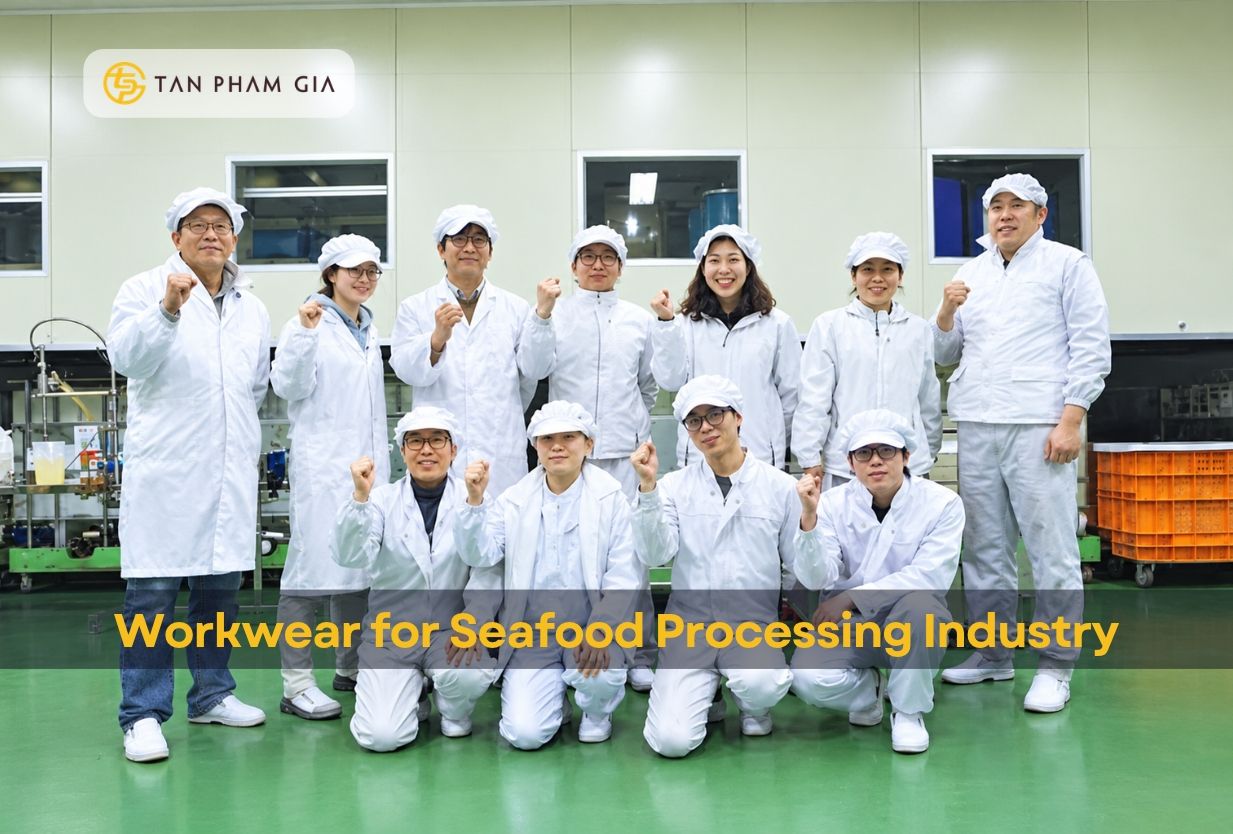
Employees in seafood processing plants regularly work around water, cold air, and raw seafood. Workwear for seafood processing industry workers must therefore support hygiene control, comfort, and freedom of movement at the same time.
Many businesses struggle to choose the right uniforms because some fabrics feel heavy, dry slowly, are difficult to wash, or create inconsistencies between departments. This article from Tan Pham Gia Uniform explains working conditions, fabric-selection criteria, HACCP and ISO considerations, and the ordering process to help businesses develop suitable seafood processing uniforms for orders of 100 sets or more.
Why Is Workwear Necessary in Seafood Processing Plants?
Workwear helps control hygiene, supports worker health and comfort, and presents a professional business image. All three factors directly affect daily operations and a facility’s ability to meet partner or customer audit requirements.
Maintain Food Safety and Hygiene
Uniforms form the first layer between employees and the food being processed. Clean, standardized garments help reduce the risk of personal clothing carrying dirt, loose fibers, or microorganisms into production areas.
When all employees follow the same uniform standard, controlling access to processing areas also becomes easier.
Support Worker Health and Comfort
Wet conditions, low temperatures, and repetitive tasks can cause fatigue and discomfort when employees wear unsuitable clothing. Lightweight, quick-drying materials and comfortable seams help workers remain comfortable during long shifts.
Depending on garment coverage and facility procedures, uniforms can also help reduce routine contact between the skin and raw materials, water, or cleaning agents used during production. They do not replace task-specific PPE where a hazard assessment requires additional protection.
Strengthen the Company’s Professional Image
A clean, well-presented uniform program creates a professional impression when business partners or audit teams visit the facility. Consistent colors, logos, and garment designs also help standardize brand identity.
What Makes Work in the Seafood Processing Industry Different?
Seafood processing plants have three main characteristics: wet working conditions, direct contact with raw seafood, and strict hygiene requirements. These factors determine the appropriate fabric, garment design, and color-coding system.
Working in Wet Conditions
Employees frequently work in areas exposed to water, moisture, and low temperatures. Their uniforms should dry quickly, minimize heat buildup, and avoid becoming excessively heavy when damp.
Thick fabrics that absorb water and dry slowly can cause discomfort, reduce mobility, and increase the risk of skin irritation when worn for extended periods.
Direct Contact With Raw Seafood
Employees responsible for preliminary processing, sorting, or packing frequently handle raw seafood. Their uniforms should be easy to wash and clean, with a fabric surface that remains stable through repeated laundering.
Garment designs should limit unnecessary details such as exterior pockets, deep pleats, or unsecured components. These features may collect residue or create a foreign-object risk in production areas.
Strict Hygiene Compliance Requirements
Processing facilities commonly follow internal hygiene procedures as well as requirements established by customers and importing partners. Uniforms should be changed according to facility procedures, cleaned using the approved process, and clearly separated by work area.
Businesses should therefore define their specific hygiene criteria before placing a uniform order.
Workwear for Different Roles in a Seafood Processing Plant
Each position in a processing plant involves different working conditions, so garment designs and materials should be selected by role. Department-specific workwear improves employee comfort and allows managers to identify each worker’s assigned area more quickly.
Preliminary Processing and Direct Processing Workers
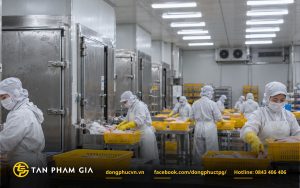
These employees have the most contact with water and raw materials, so they need lightweight, quick-drying, and easy-to-clean uniforms. Streamlined designs with fewer unnecessary details support efficient movement and easier sanitation.
Businesses commonly combine these uniforms with hair coverings and masks according to their facility’s own requirements.
Cold-Storage and Freezer-Storage Employees
Cold-storage employees work at low temperatures and move continuously. Their clothing system must be specified separately according to the actual temperature, exposure time, task, and facility risk assessment so that it provides the required thermal protection without unnecessarily restricting movement.
The lightweight fabrics discussed later in this article are not substitutes for specialized cold-storage PPE. Color differentiation can still be used to distinguish cold-storage personnel from employees in processing areas.
Plant Managers and Supervisors
Managers and supervisors move between multiple work areas. Their uniforms should be neat, easy to identify, and compatible with the hygiene requirements of any production area they enter.
Distinctive colors or identifying details help employees, visitors, and business partners recognize supervisory roles within the facility.
Quality Control Personnel
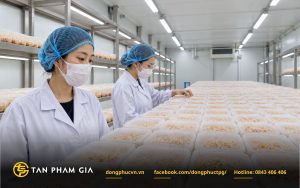
Quality control employees work in areas with high cleanliness requirements and frequently inspect products at close range. Their uniforms should be clean, low-lint, made from a stable fabric, and clearly distinguishable from production uniforms.
A separate color for the quality control team also makes internal monitoring more convenient.
Uniform categories for preliminary processing, cold storage, supervision, and quality control should be planned from the beginning to maintain consistency across a large-scale rollout. Tan Pham Gia Uniform’s completed projects can provide references for garment design, color identification, and allocation by work area.
Which Fabrics Are Suitable for Workwear for Seafood Processing Industry Workers?
Suitable fabrics for seafood processing facilities should be lightweight, quick-drying, easy to wash, and comfortable for extended wear. The following five fabric groups are commonly recommended by Tan Pham Gia Uniform for this type of environment.
Micro Fabric – Lightweight and Quick-Drying for Seafood Processing Environments
Micro Fabric has a lightweight surface and provides a drier feel when employees work around water. Businesses often consider it when they want to reduce the heavy feeling experienced by workers who remain on their feet for long shifts.
Kate Silk Fabric – Soft and Comfortable for Areas With High Cleanliness Requirements
Kate Silk Fabric has a soft surface that supports comfort during continuous work. It is often considered for roles that require a neat, clean appearance in hygiene-sensitive areas.
Kate Ford Fabric – Lightweight and Comfortable for Extended Wear
Kate Ford Fabric feels light and breathable, helping reduce stuffiness during long working hours. Businesses commonly select it for employees who need to move flexibly throughout a shift.
Kaki Thun Fabric – Flexible for Preliminary Processing and Packing
Kaki Thun Fabric provides flexibility that supports bending, leaning, and repetitive movement. This is an important consideration for production stages involving continuous physical activity.
Kaki Fabric With 65% Polyester and 35% Cotton – Balancing Durability, Breathability, and Easy Care
Kaki 65/35 Fabric is suitable when a business needs uniforms that remain durable through repeated washing while still providing breathability. The material is also practical for the care and laundering of large uniform quantities.
Which materials should be used for preliminary processing workers, cold-storage personnel, and quality control employees to balance hygiene requirements and workplace comfort? Businesses can review Tan Pham Gia Uniform’s fabric-selection guide before approving a final option.
HACCP and ISO Standards Applied to Workwear for the Seafood Processing Industry
HACCP and ISO 22000 relate to food safety management across the processing facility; they are not certifications for individual uniforms. Employee clothing is nevertheless one of the hygiene-control elements that a food business must manage.
Within food safety controls, employee clothing may become a contamination source if it is not properly selected, used, and maintained. The objective is to prevent loose fibers, detachable components, or microorganisms carried by clothing from entering seafood products during processing.
Based on this principle, businesses should consider the following points when specifying workwear for seafood processing industry facilities:
Specific requirements – such as cleanroom classifications or permitted fiber types – depend on each facility’s HACCP plan, internal hygiene program, applicable regulations, and customer audit requirements. Businesses should review their internal standards before approving fabrics and garment designs.
Workwear should be reviewed as part of the plant’s overall hygiene-control process, especially when production areas have different requirements. Businesses can provide Tan Pham Gia Uniform with their hygiene procedures and work-area layout so that the proposed uniform system can be aligned with each department.

The Ordering Process for Workwear for Seafood Processing Industry Workers
The ordering process includes seven steps, from defining requirements to final delivery. Each step helps businesses control quality and reduce inconsistencies during bulk production.
- Step 1: Define Uniform Requirements for Each Position – The business provides the number of employees, their job roles, and the working conditions in each area. This information provides the basis for selecting suitable garment designs, fabrics, and colors.
- Step 2: Receive Fabric and Hygiene-Requirement Recommendations – Tan Pham Gia Uniform recommends fabrics based on the conditions in each work area and reviews the hygiene requirements currently applied by the business.
- Step 3: Develop a Free Design for Wet Working Conditions – The design is developed for each position, with attention to pockets, seams, and logo placement. The business can review the design and request revisions before approval.
- Step 4: Approve Fabrics and the Sample Garment – The business reviews the actual fabric and sample garment to evaluate breathability, softness, and fit. This step helps identify unsuitable details before bulk production.
- Step 5: Review and Evaluate the Uniform Sample – Selected employees wear-test the sample in the actual working environment. The business then compiles feedback and requests any necessary adjustments before mass production.
- Step 6: Begin Bulk Production – After the final sample is approved, the order enters production according to the confirmed specifications. Quantities, sizes, and allocations by department are reviewed before sewing begins.
- Step 7: Conduct Quality Control and Deliver the Uniforms – Products are inspected at each production stage before packing and delivery. Uniforms are sorted by department so that the business can receive and distribute them more efficiently.
Pricing for Workwear for Seafood Processing Industry Workers
The cost of seafood processing uniforms depends on the fabric, quantity, garment design, and logo application method. Tan Pham Gia Uniform does not apply a fixed price to every project; each quotation is prepared according to the business’s specific requirements.
Factors That Affect the Cost of Workwear for Seafood Processing Industry Workers
- Selected fabric and fabric weight: Materials with different structures and weights have different costs.
- Order size and production quantity: Larger orders generally provide better cost efficiency.
- Garment style, construction, and design requirements: Designs with more details or multiple layers require additional production steps.
- Printing, embroidery, and brand-identity requirements: The number, size, and placement of logos affect finishing costs.
- Sizing, departmental allocation, and conditions of use: Projects involving multiple size groups and departments require more detailed production planning.
Request Consultation and a Project-Specific Quotation
Businesses can submit their requirements through any of the following channels:
- Hotline/Zalo: 0843 406 406
- Email: dongphuc@tanphamgia.com.vn
- Consultation and quotation form: Complete the request form
- Visit the factory: 20A TA15 Street, Thoi An Ward, Ho Chi Minh City, Vietnam
Ordering Workwear for the Seafood Processing Industry From Tan Pham Gia Uniform
Tan Pham Gia Uniform provides corporate uniform solutions with a focus on bulk orders and consistency across the workforce. With more than 23 years of experience in fashion and garment manufacturing, Tan Pham Gia Uniform has worked with over 500 businesses and produced more than 1,000,000 garments.
The production process combines traditional dress-form draping and fit refinement with a structured quality control system to help manage garment fit and consistency across the order.
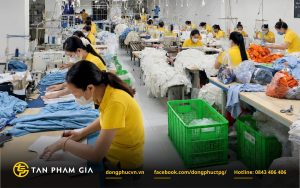
- Solutions for Businesses Ordering 100 Sets or More: Tan Pham Gia Uniform serves uniform orders starting from 100 sets, making the service suitable for processing facilities, factories, and multi-site production operations. Orders are planned by position, department, and size to reduce allocation errors.
- Specialized Fabric Options for Seafood Processing Environments: Tan Pham Gia Uniform recommends lightweight, quick-drying, and easy-to-wash fabrics for wet working environments, including Micro, Kate Silk, Kate Ford, and Kaki Thun fabrics.
- Recommendations Based on the Working Environment and Budget: The consulting team considers the conditions in each work area, hygiene requirements, and the available budget when developing a suitable proposal. Businesses can review and adjust the proposal before final approval.
- Fast Nationwide Supply and Delivery Across Vietnam: Tan Pham Gia Uniform delivers uniforms to provinces and cities throughout Vietnam. Orders can be separated by department or facility to make receiving and internal distribution more convenient.
Frequently Asked Questions About Workwear for Seafood Processing Industry Workers
Questions 1. What Standards Should Seafood Processing Workwear Meet?
Uniforms should meet the facility’s internal hygiene requirements and support the food safety controls applied through its HACCP plan and ISO 22000 food safety management system. Key considerations include controlling loose components, supporting effective laundering, maintaining durability, and separating garments by work area. Exact requirements depend on each facility and its customer requirements.
Questions 2. Which Fabrics Are Suitable for Seafood Processing Environments?
Suitable options may include lightweight, quick-drying, easy-to-wash fabrics that remain comfortable during extended wear, such as Micro, Kate Silk, Kate Ford, Kaki Thun, or Kaki fabric with 65% polyester and 35% cotton. The final selection depends on the employee’s role and level of physical activity.
Questions 3. Should Uniform Colors Be Different for Each Position?
Yes. Role-based color coding helps managers identify assigned work areas, supports access control, and reduces confusion between processing, cold-storage, and quality control teams. Each business should establish its own color-coding rules.
Questions 4. Can a Small Business Order Custom Workwear?
Tan Pham Gia Uniform focuses on orders of 100 sets or more. Businesses requiring fewer than 100 sets can call +84 843 406 406 to discuss available options.
Questions 5. What Factors Determine the Price of Seafood Processing Workwear?
Pricing depends on the fabric, quantity, garment design, printing or embroidery requirements, and size allocation by department. Tan Pham Gia Uniform prepares quotations based on the actual requirements of each business rather than applying one fixed price.
Contact Tan Pham Gia Uniform for Consultation and a Quotation
In summary, selecting the right workwear for seafood processing industry facilities begins with assessing wet working conditions, hygiene requirements, and the responsibilities of each role. From initial consultation to final delivery, Tan Pham Gia Uniform provides workwear uniforms solutions within a broader range of uniform solutions tailored to each business’s operational needs.
- Submit a request through Hotline/Zalo: Call or message +84 843 406 406 to discuss quantities, job roles, and hygiene requirements.
- Complete the consultation form: Provide the basic project information, and a Tan Pham Gia Uniform specialist will contact you to discuss fabrics and garment design.
- Receive a proposal and quotation: After reviewing the submitted information, Tan Pham Gia Uniform will provide a recommended uniform solution and quotation based on the business’s actual requirements.