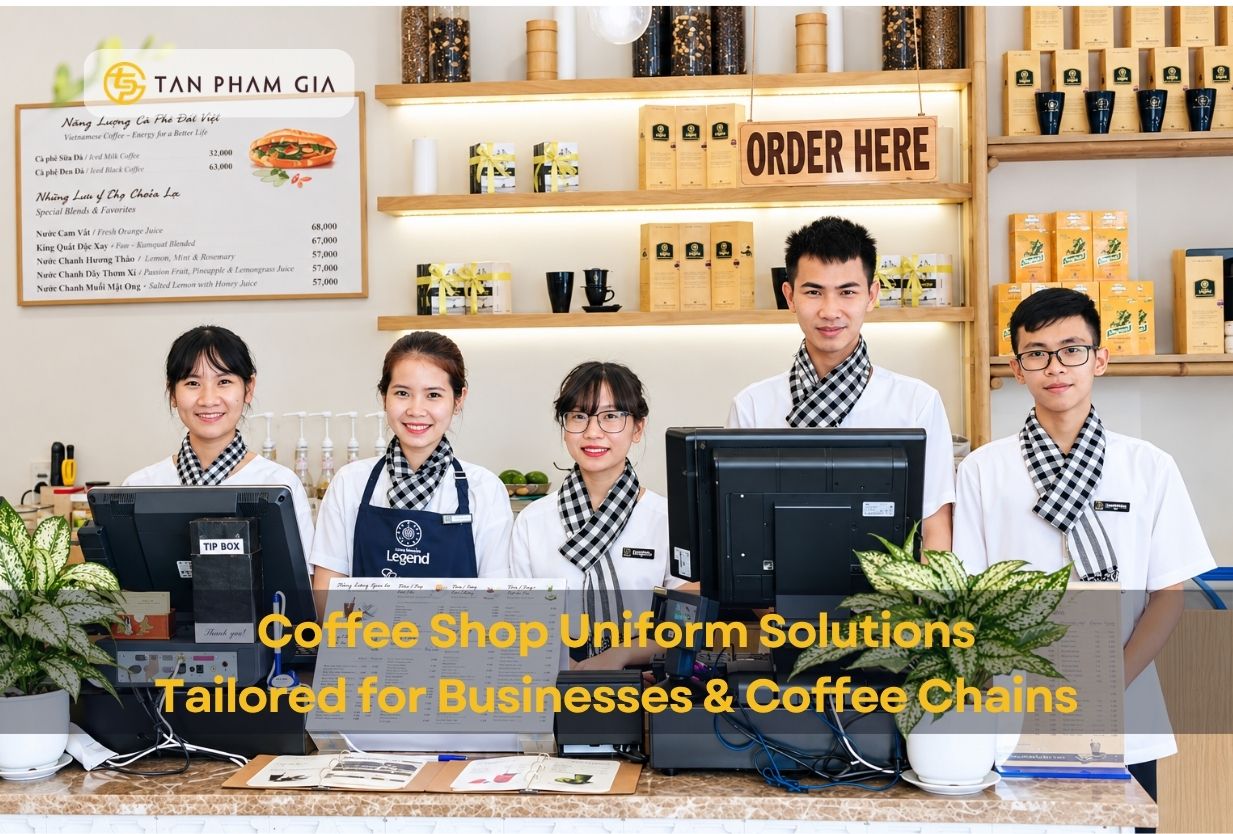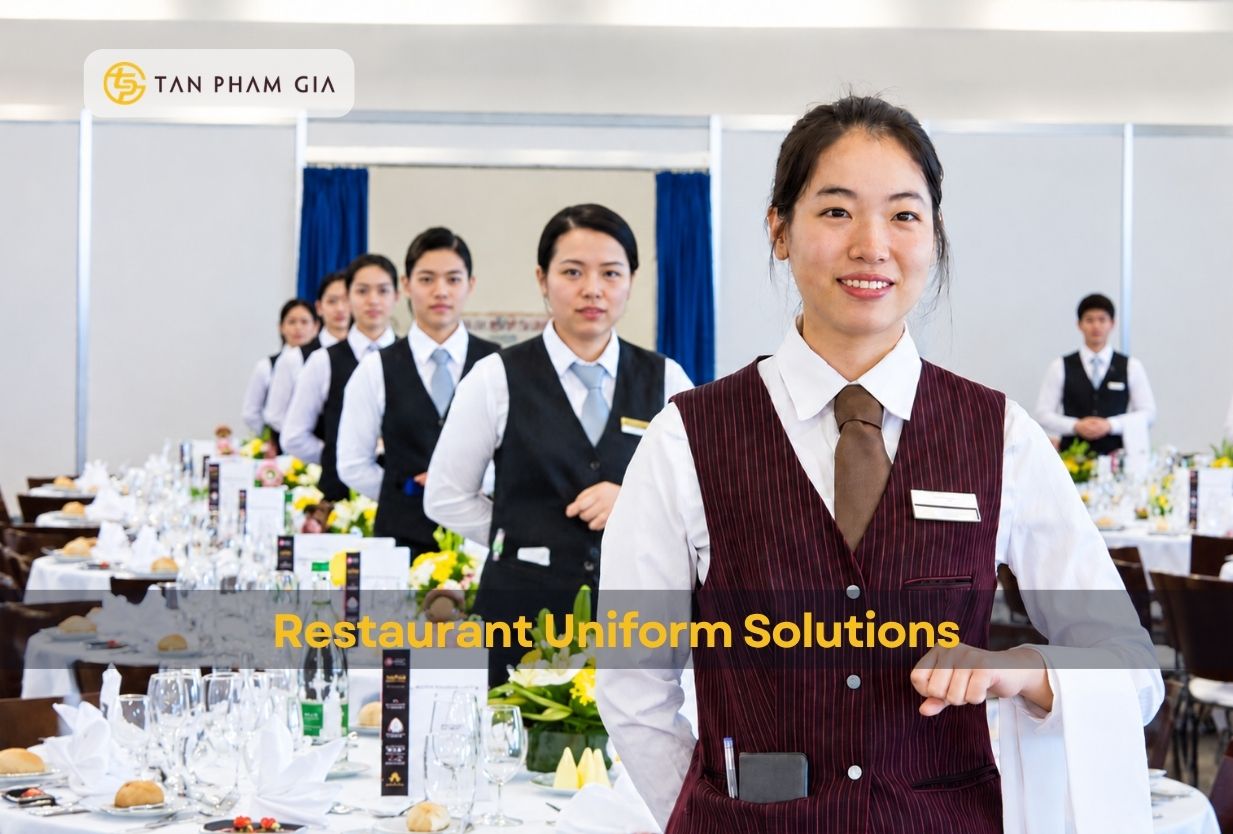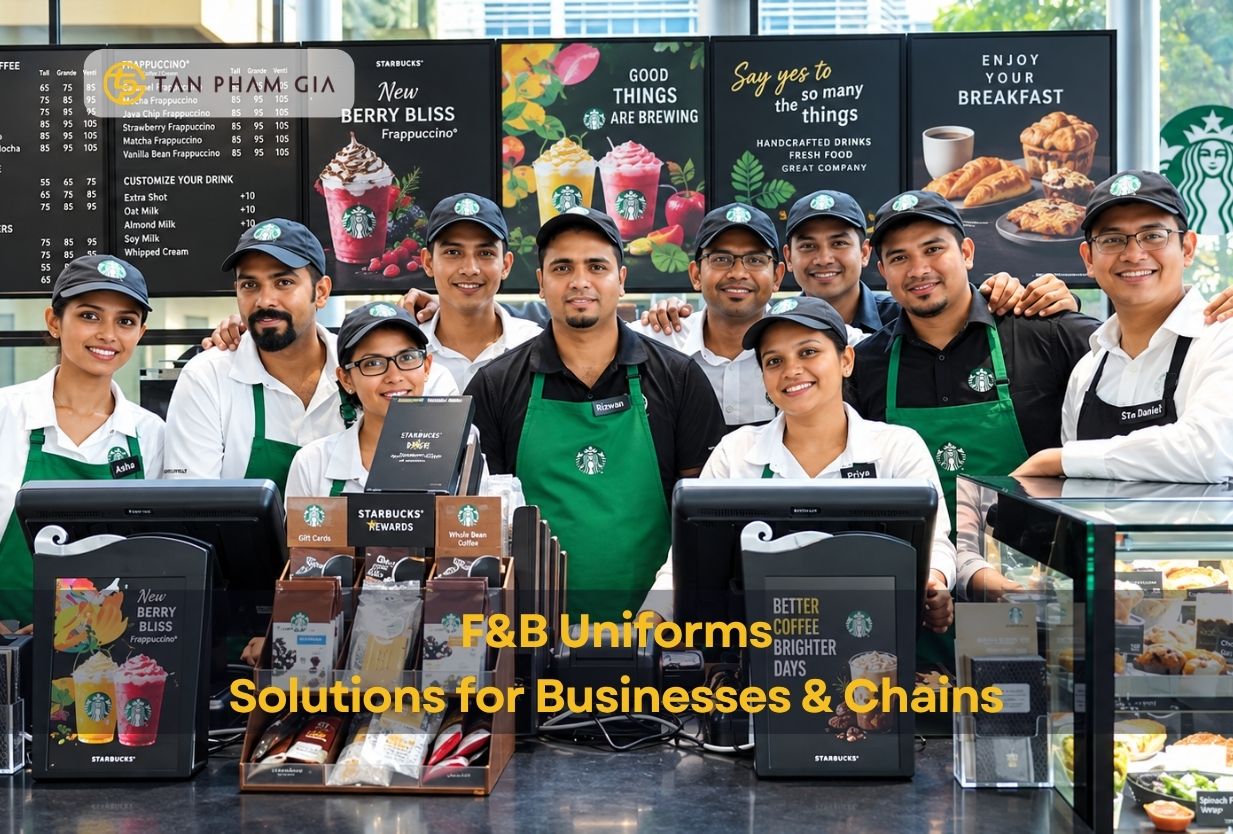
An F&B uniform program brings together workwear for restaurants, cafes, bakeries, bars, and food service chains. It should communicate your brand identity while supporting employees in their daily work.
Shift work, frequent movement, heat, spills, grease, and repeated laundering all affect uniform performance. Many businesses find that garments lose their shape too quickly or become difficult to coordinate across departments and locations.
This guide explores working conditions, role-specific garment options, fabric selection, and procurement planning. Tan Pham Gia Uniform approaches food and beverage uniforms as a coordinated solution for branding and operations, with each garment selected around the needs of the team.
What Is F&B, and What Makes F&B Uniforms Different?
F&B uniforms need to meet two demands: present a recognizable brand image to customers and withstand frequent use in environments involving heat, water, food, and grease.
These demands influence garment styles, fabric choices, and the number of uniform sets each employee needs.
What Does F&B Mean?
F&B stands for Food and Beverage. The industry includes:
- Restaurants.
- Cafes.
- Bakeries.
- Bars.
- Catering businesses.
- Food and beverage chains with multiple locations.
Each business model has different working areas and staff responsibilities, so uniform requirements vary accordingly.
Working Conditions That Affect Uniform Selection
Six characteristics directly influence food and beverage uniform planning:
- Frequent customer interaction: Staff uniforms are a visible part of the customer’s first impression.
- Continuous movement: Garments should allow employees to serve, prepare drinks, and move without restriction.
- Exposure to heat, water, grease, and food: Materials need to suit the working area and be practical to clean.
- Shift work: Employees may wear uniforms for extended periods, making comfort a priority.
- Frequent wear and laundering: Fabrics and construction need to retain an acceptable appearance over repeated use.
- Different roles and requirements: Service, counter, kitchen, and support teams need garments appropriate to their tasks.
What Should an F&B Uniform Program Deliver?
Use these six criteria when comparing uniform options:
- Brand recognition: Colors, logos, and styling should reflect your business.
- Comfort and movement: Fit and fabric should support daily tasks.
- Suitability for the working area: Select garments for service, counter, kitchen, or support roles.
- Practical care: Consider washing requirements, drying time, and wrinkle behavior.
- Durability: Review shape retention and colorfastness against the expected frequency of use.
- Consistency across locations: Establish shared color, fit, and logo specifications.
Need Help Standardizing Your F&B Uniforms?
Each role has different working conditions and garment requirements. Tan Pham Gia can recommend styles, fabrics, and branding details based on your staffing structure and operational scale.
Why Should F&B Businesses Invest in Staff Uniforms?
Uniforms help standardize staff appearance, support daily coordination, and simplify uniform management as a business grows.
For chains, a consistent collection also helps customers recognize the brand at every location.
Create a Consistent Brand Appearance
Uniforms repeat your colors, logo, and design style across customer interactions.
A shared appearance helps service areas look organized and reinforces the identity of each location.
Make Employees Easy to Identify
Customers can quickly recognize the right person to approach when ordering, asking a question, or requesting assistance.
This is particularly useful in busy venues or spaces with several service areas.
Distinguish Staff Roles
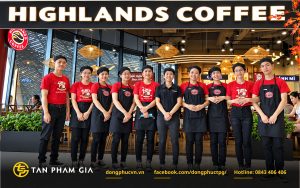
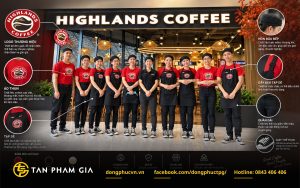
Different styles or color details can identify servers, baristas, managers, kitchen staff, and support teams.
These distinctions make roles easier to recognize during daily operations and shift coordination.
Support the Customer Experience
Neat, coordinated apparel contributes to a professional impression when customers enter.
Comfortable uniforms also help employees focus on their work throughout the shift.
Maintain Consistency Across a Chain
Uniforms should follow the same approved colors, fit specifications, and logo details, even when produced in separate batches.
Achieving this requires production references and quality control alongside a consistent design.
Simplify Uniform Management
Businesses with large teams need clear size charts, role-based garment allocations, and an organized distribution plan.
Defining these requirements early makes it easier to equip new employees and coordinate replacement orders.
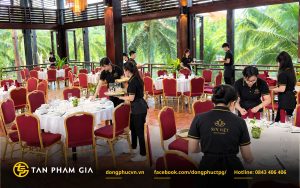
F&B Uniform Styles for Different Staff Roles
Common garments include polos, button-up shirts, aprons, cleaning staff uniforms, and chef uniforms.
Choose each garment around the role, then coordinate the collection through shared colors and branding.
Uniform Polo Shirts for Service, Cafe, and Store Teams
Uniform polo shirts are a practical choice for staff who stay active and interact with customers throughout their shifts.
They offer a neat appearance, provide space for branding, and can suit a less formal uniform style during long shifts.
Common applications include:
- Servers.
- Cafe staff.
- Store team members.
- Takeout counter staff.
- Operations teams.
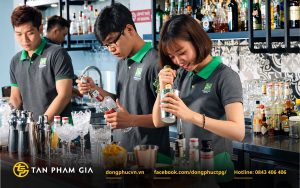
Button-Up Uniform Shirts for Managers and Service Staff
Uniform button-up shirts are ideal for roles that call for a polished appearance or help distinguish managers and supervisors from other staff.
They are commonly selected for:
- Restaurant managers.
- Supervisors.
- Hosts and reception staff.
- Servers.
- Restaurants and cafes with a more formal service style.
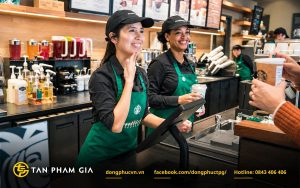
Uniform Aprons for Baristas, Bartenders, and Counter Staff
Aprons help protect the clothing underneath from everyday splashes and provide a visible area for branding.
They are commonly used by:
- Baristas.
- Bartenders.
- Counter staff.
- Servers.
- Teams working in prominent customer-facing areas.
Choose the apron length, coverage, and pocket arrangement according to the employee’s tasks.
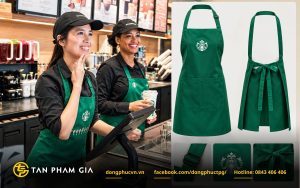
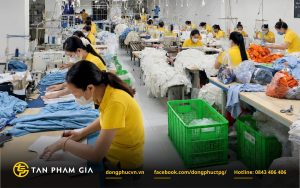
Cleaning and Support Staff Uniforms
Uniforms for cleaning and support teams should prioritize durability and practical care.
Typical users include:
- Cleaning staff.
- Support staff.
- Back-of-house teams.
Review the material and care instructions against the actual washing process and cleaning products used in the workplace.
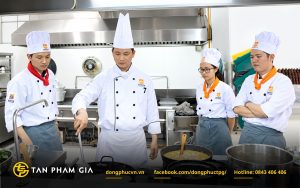
Chef and Kitchen Staff Uniforms
Kitchen uniforms need to account for warm working conditions, grease, and frequent movement.
This category includes garments for:
- Chefs.
- Executive and head chefs.
- Assistant cooks.
- Food preparation staff.
Select the garments and materials around the specific kitchen tasks and working area.
Not Sure Which Uniforms Suit Each Role?
Send your staff roles, estimated quantities, and working conditions to Tan Pham Gia. The team will recommend options for service, management, barista, bartender, kitchen, and support teams.
Fabric Solutions for F&B Uniforms
Choose fabrics according to the working environment and intensity of use. One material is unlikely to suit every role.
GSM, or grams per square meter, describes fabric weight. Higher-GSM fabrics are heavier per unit area, while lower-GSM fabrics are lighter. Thickness, structure, and breathability also depend on fiber content, construction, and finishing.
Fabrics for F&B Uniform Polo Shirts
The TPG Fabric Collection™ includes several options for polo uniforms. Royal Pique™ is presented as a commonly selected option, while CoolDry Pique™, AirFlex™, and Micro Grid Air™ are also recommended for relevant food and beverage roles.
Local trade references are retained for product identification; they are not standardized English fabric specifications.
Use the following priorities as a starting point:
- A substantial, structured feel: Review Royal Pique™ or CoolDry Pique™, including their performance under your laundry process.
- A lighter garment: Consider AirFlex™ for cafe and similar service settings.
- Stretch for movement: Review Micro Grid Air™ and assess the finished garment’s fit and stretch recovery.
- A cotton-rich feel: Consider CottonFlex™.
- More active applications: Discuss AeroGrid™ and AirMax Tech™ before using these sport-oriented fabrics in an F&B uniform program.
Review physical swatches and sample garments to assess weight, surface texture, and comfort.
Fabrics for F&B Button-Up Shirts
Shirting materials should balance presentation, comfort, and suitability for repeated laundering.
Fabrics for F&B Aprons
Assess apron materials against five criteria:
- Durability: Suitability for friction and repeated washing.
- Ease of cleaning: Spill treatment, washing requirements, and drying time.
- Shape retention: How the apron hangs and maintains its appearance during use.
- Color coordination: Compatibility with brand colors and the garments worn underneath.
- Logo application: Suitability for clear, durable printing or embroidery.
Fabrics for Chef and Kitchen Staff Uniforms
Review these five priorities for kitchen apparel:
- Suitability for the working temperature: Consider comfort and the actual exposure conditions.
- Durability: Assess wear resistance and compatibility with the laundry process.
- Freedom of movement: Garments should support preparation and cooking tasks.
- Ease of cleaning: Review how food and grease marks can be treated.
- Repeated-use performance: Check shape and color retention under the expected care routine.
For roles close to high-temperature equipment, discuss the actual exposure with the manufacturer before selecting a material. Fabric weight and comfort alone do not establish protective performance.
Match Materials to Each F&B Role
Need Help Selecting Fabrics?
Tan Pham Gia recommends materials according to staff roles, working conditions, laundering frequency, and comfort and durability requirements. Request a consultation and review physical samples before deciding.
Eight Steps to Choosing F&B Uniforms for Your Business
A clear selection process helps reduce changes and unexpected costs during bulk production.
- Assess Each Role’s Working Environment
List the conditions for each position: proximity to heat, exposure to water or grease, and frequency of movement.
Use this information to guide garment and fabric selection.
- Choose Styles Around Staff Responsibilities
Polos may suit service and store teams, button-up shirts may suit management, and aprons may suit counter and beverage preparation roles.
Include enough visual distinction for staff responsibilities to be recognizable.
- Match Materials to the Intensity of Use
For frequently worn and washed garments, review shape retention, colorfastness, and care requirements.
For other roles, weigh softness, garment structure, and comfort according to the actual working conditions.
- Coordinate Colors with Your Brand
Use your brand palette and consider how the colors work within each location.
Provide color references where available and approve physical swatches to help control variation between production runs.
- Define Logo Placement and Application
Decide whether logos belong on the chest, sleeve, back, or apron.
Choose printing or embroidery according to the fabric, artwork detail, and desired appearance. Review the application on the actual material before approval.
- Build an Accurate Size Breakdown
Collect measurements or confirmed garment sizes rather than estimating.
For example, before ordering 100 polos, prepare quantities by size, selected fit, and location. This helps reduce shortages and excess stock in unsuitable sizes.
- Plan for Additional Locations
Keep records of approved fabrics, colors, garment measurements, and logo details.
These references support future orders when your chain expands or hires new employees.
- Approve Samples Before Bulk Manufacturing
Check the fit, colors, fabric, and branding on physical samples.
Have employees test the garments during representative tasks to assess comfort and movement before final approval.
What Affects F&B Uniform Costs?
Pricing depends on seven main factors. Tan Pham Gia prepares quotations around each business’s quantities, staff roles, and specifications.
- Order Quantity: Larger production runs may improve costs per garment. Consolidating requirements across locations can help identify efficiencies compared with placing separate orders.
- Garment Style and Design Complexity: Additional panels, color combinations, construction details, or custom pattern development can increase production work. Define the required features early when comparing options.
- Fabric Selection: Fiber content, weight, construction, and finishing all influence material costs. Choose a fabric around its intended use rather than automatically selecting the highest- or lowest-priced option.
- Logo Printing or Embroidery: Logo size, color count, detail, application method, and the number of placements affect cost. Review both the price and the finished result on the selected fabric.
- Construction Details and Accessories: Collar trim, sleeve cuffs, buttons, zippers, pockets, and accessories can change production requirements. Specify the necessary details during design development.
- Packaging and Sorting: Sorting garments by size, role, or location can make distribution easier. More detailed packing requirements involve additional handling, so include them in the quotation brief.
- Number of Roles and Locations: More staff roles can mean more designs, materials, and size groups. Larger uniform programs require coordinated production planning and quality control.
The F&B Uniform Ordering Process at Tan Pham Gia
The process includes seven stages, from the initial consultation to delivery.
- Step 1: Requirements Consultation: Discuss staffing numbers, roles, working conditions, and brand identity.
- Step 2: Style and Fabric Selection: Review garment styles and fabric options for each staff group.
- Step 3: Design Development: Finalize the designs, color combinations, logo placement, and application methods.
- Step 4: Sample Approval: Review and approve physical samples before bulk manufacturing begins.
- Step 5: Production: Manufacturing follows the approved samples and specifications. Traditional draping on a dress form supports fit development during the design and sampling stages.
- Step 6: Quality Control: Checks at multiple production stages help control consistency across the order.
- Step 7: Packing and Delivery: Garments are packed and sorted according to the agreed size or role breakdown and delivered according to the project plan.
Tan Pham Gia: Custom F&B Uniform Manufacturing
Tan Pham Gia provides custom corporate uniform solutions for B2B clients, from design and manufacturing to finishing.
The focus is on bulk orders that need consistent branding, controlled quality, and garment options suited to different staff roles.
For food and beverage businesses, four capabilities support this approach:
- A dedicated fabric collection: Materials are selected according to the environment and requirements of each role.
- Fit development through draping: Traditional draping on a dress form supports garment shaping and sample refinement.
- Production and quality control: Bulk manufacturing is supported by checks at multiple stages.
- Industry-specific design recommendations: Styles, colors, and logo applications are developed around the business model and brand identity.
Frequently Asked Questions About F&B Uniforms
Questions 1. What Garments Are Included in an F&B Uniform Program?
Common options include polos, button-up shirts, aprons, cleaning staff uniforms, and kitchen uniforms.
Each category suits different roles, such as servers, managers, baristas, support staff, and chefs. Define your staffing structure before selecting the garment combinations.
Questions 2. Which Fabrics Suit F&B Uniform Polo Shirts?
The choice depends on working conditions and frequency of use.
Tan Pham Gia recommends reviewing Royal Pique™ and CoolDry Pique™ for relevant F&B roles, AirFlex™ for cafe settings, and Micro Grid Air™ for restaurant and service teams.
Compare physical samples before making the final selection.
Questions 3. How Should We Choose F&B Uniform Colors?
Start with your brand palette and consider the interior of each location.
Also review how readily marks will show and how shirts, aprons, and department-specific garments coordinate. Provide brand color references and approve actual fabric swatches.
Questions 4. What Should We Prepare Before Ordering?
Prepare employee numbers, staff roles, estimated size quantities, logo artwork, and brand color references.
Describe the working conditions for each role so the manufacturer can recommend suitable styles and materials.
Questions 5. How Many Uniform Sets Should Each Employee Receive?
Consider providing more than one set so employees can rotate clean uniforms between shifts.
The appropriate quantity depends on shift patterns, laundry arrangements, and budget. Tan Pham Gia can recommend an allocation based on your operations.
Questions 6. Does Tan Pham Gia Provide F&B Uniform Quotes?
Yes. Quotations are prepared around quantities, garment styles, fabrics, and logo requirements.
Call +84 843 406 406 or submit the consultation form to discuss your project.
An effective food and beverage uniform program starts with staff roles, working conditions, and brand identity.
Clear specifications for styles, fabrics, logos, sizing, and sample approval make it easier to manage quality and costs across bulk orders.
Tan Pham Gia helps businesses develop coordinated uniforms for their operational needs.
Looking for Uniforms for Your F&B Business or Chain?
From restaurants and cafes to bakeries, bars, and multi-location chains, Tan Pham Gia recommends uniforms based on staff responsibilities, working conditions, materials, branding, and production requirements.
Provide your staffing numbers, roles, working environments, and brand guidelines. The team will recommend suitable options and prepare a quotation for your project.